Absolute beginnings – which way to go?
Machine translation.
This page was machine-translated from Czech. The Czech version is authoritative.
Switch to original Czech version. · Zobrazit originál článku v češtině
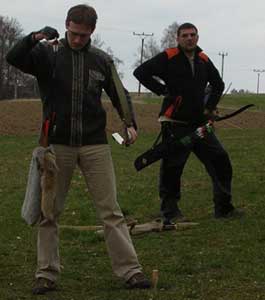 Regular visitors to the discussion forum of the Lukostřelec.cz portal, as well as participants in traditional archery competitions, will be familiar with the little fellow nicknamed SanDuro. He still calls himself an archery beginner (even despite his recent 5th place in the individual event and 1st place in the team event at the Czech Championship in FITA field archery). What he learned during his "beginner" era and subsequently under the personal guidance of Milan Hladil, he tries to pass on to all those who are at the very beginning and do not yet know how to go about it.
The first instalment of a short series is now appearing on your screens, in which San will try to summarise, from his own point of view, some basic information about correct technique and other essential "little things".
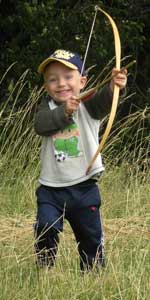 At tournaments and traditional archery events I often meet people who have difficulty hitting the target. There are usually two main reasons. Either their bow is not matched to their arrows, or their archery technique is poor. Most often it is a combination of both. The archer thus ends up in a vicious circle. With badly combined equipment, they cannot tell what mistake they made in the shot, because with an unsuitable combination of bow and arrows it cannot be determined at all. On the other hand, an archer without a precisely mastered shooting technique cannot tune their own equipment.
The aspiring archer is then faced with a devilish question: What should I do first? Tune the bow, or first perfect the archery technique? And now try to answer that.
My personal opinion is that shooting technique comes first. That is why I recommend that an aspiring archer first get a simple bow with suitable arrows and work on technique. Tuning the bow and arrows is different for every person. That means archers must tune their bow themselves, and for that a correct shooting technique is essential. Moreover, most people buy a new bow anyway once they have mastered correct technique, usually a somewhat stronger (and usually more expensive) one.
If someone wants to take the long and thorny road and try everything on their own, they must arm themselves with great patience and be the self-study type. It is also useful to know a foreign language, preferably English. Then it is possible to find a great deal of information on the internet or in (mostly foreign) publications that will help a beginner find their way. A good aid in such a case is also a video camera with a tripod, on which the aspiring archer can film their shooting attempts and then analyse them and compare them with available pictures or video materials. However, this self-taught path is also the thorniest one you can take.
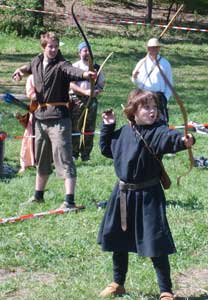 If you want to follow more well-trodden paths, there is nothing for it but to find a coach who will help the archer master correct shooting technique and tune the shooting equipment. An aspiring archer acquires the basic correct archery technique only after several thousand arrows shot, which with regular training two to three times a week takes approximately three months. The assistance of a coach is highly recommended, especially at the very beginning. The worst thing that can happen to a person is to start training alone with unsuitable equipment and acquire bad habits. Reworking poor technique is very difficult, and often one has to start again from scratch with the assistance of a coach. I have been through it myself, so I know what I am talking about.
A good coach will tell you when the time has come to start training independently, and his assistance will be needed only at, say, every third or fourth training session. After that he will only check your technique, fine-tune details, and later step in only when the archer needs assistance. Another thing, besides technique, that the archer learns is the ability to "read" an arrow on the target face. From the position of the arrow, it is possible to identify quite precisely the technical error the archer made. For example, if an archer regularly shoots low (the arrows land low), it may indicate that the archer lowers the bow arm too quickly because they are trying to follow the flying arrow.
So you have decided on the individual path or on the assistance of a coach, and you start thinking about a bow. The first thing to consider is the draw weight of the bow. Draw weight is usually given in pounds at a draw length of 28 inches, and it is marked on the bow, for example, like this: 35# / 28'' (or 35 lbs / 28''). I will not go into unnecessary detail about the various ways to measure draw length. I recommend visiting a bow dealer, who will advise you on the choice, or following the advice of your coach, if you have one.
Starting with a macho 65-pound bow may boost your self-confidence, but with such a bow you will not learn correct technique. You will just needlessly wrestle with the bow, and you may not only acquire bad habits but also cause yourself nasty injuries to the shoulder or spine. Unless you are a bodybuilder, I do not recommend starting with a bow stronger than 30 to 35 pounds.
The time has now come when the archer is ready to fly the nest, buy a new bow and match it to their arrows, so that they can further develop their archery form and ability. I venture to point out that we have so far completely skipped the matter of aiming. The first question I usually get from beginners is: "And how am I supposed to aim?" My answer is simple: "Don't aim. We'll learn that once you know how to shoot a bow."
Further articles will follow in the logical order in which an archer should proceed: archery technique, tuning of archery equipment, and finally the various methods of aiming used in traditional archery.
Best regards, beginner San.
You can discuss the article here.