Arrows and Bows from Nydam
Machine translation.
This page was machine-translated from Czech. The Czech version is authoritative.
Switch to original Czech version. · Zobrazit originál článku v češtině
It is generally assumed that the Germanic peoples did not attach great importance to bows. That does not necessarily mean, however, that they did not use bows at all. Since we do not find them in burial mounds or at sacrificial sites, the bows probably served them more for hunting than as a weapon of war. The find of bows in the Nydam bog (1863, southern Denmark), which were dated to the later Roman period (200 – 400 AD), nevertheless points to the growing importance of the bow as a weapon, especially after the local inhabitants encountered Roman archers. The Saxons and Angles, who lived here at that time and later expanded into Britain, probably took their bows and arrows with them as well. It is assumed that the Nydam bows that were found may be the ancestors of the later famous Saxon and English longbows. Parts of arrows The longbow of this period is made from a single piece of yew wood and has an overall length of 170 to 200 cm. The back of the bow is made of sapwood and the belly is carved from dark heartwood. In this way the bowmaker exploited the excellent properties of yew wood, which we can describe as a "natural composite."
The bows that were found have 7 to 20 growth rings per cm, mostly 11 to 16, and in one case even 30 growth rings per cm. The bows are mainly made from thin yew stems, and they are therefore knotty. Good wood without knots was probably hard to come by in this region. One bow made of pine wood was also found in the bog, even though pine is entirely unsuitable as a material for building a bow. The most likely explanation is that this bow was meant to deceive the god to whom it was sacrificed.
The Nydam bows have an oval or circular cross-section, or are D-shaped. The dimensions of the middle part of the bow are around 3.15 x 2.83 cm, and the dimensions of the cross-section at its ends, by the nocks for the bowstring, are around 1.5 x 1.3 cm. Some bows have a point made of iron or antler at the upper end, so that the archer could in an emergency also use his bow for close combat, which increased his chance of saving his own skin in a fight. This conclusion, however, is only one possible explanation of the likely purpose of these points on the bow, since other explanations of these "decorations" at the ends of bows can also be found.
The bows that were found do not have the nock for the bowstring placed right at the end of the bow, but mostly about 5 cm above the end (in some cases, however, it was placed lower). On each limb of the bows there is only one nock for the bowstring, with an average depth of 0.35 cm. No bowstring has survived with any of the bows that were found. Some of the bows also had a string peg, which kept the bowstring in place when it was unstrung. The binding on the bow was only partial and served for repair or as a gripping section, or possibly also as decoration.
As part of the research into the Nydam finds, these bows and arrows were reconstructed and tested. With draw weights of the bows from 25 kg (55 lbs) to 29 kg (64 lbs), an arrow can be shot as far as about 170 m and, like a nail through a plank, pierces a mail shirt and a shield without difficulty. Many bows show signs of cuts or breaks. As already mentioned, it is hard to prove whether this was deliberate or whether the damage really occurred when the bow was used in battle or on a hunt. Some arrow points that were found together with the bows bear traces of use and are clearly bent from striking a solid obstacle or a shield boss.
The arrow points from the Nydam site are mostly iron, but bone points and points made of antler were also found. Arrow points with a broad blade in the shape of a laurel leaf were also found, which were used both for hunting and for war. Among the finds, however, slender points predominate, which can pierce a mail shirt and a shield. These points resemble the medieval bodkins fitted against heavily armoured men in armour. With the points that were found it is almost the rule that broad points have a socket and narrow points a tang.
The shafts of the arrows that were found were made of ash (12 to 14 pieces) or of pine (the other arrows). The pine arrows have 6 to 20 growth rings per cm, the ash arrows 2 to 7 years per cm. The length of the shafts ranges between 75 and 80 cm, and some of them have dimensions in the range of 63 – 85.4 cm. The diameter of the shafts ranges between 8 and 10 mm. The shafts bear various scratches of uncertain meaning, but it is possible that they are maker's or ownership marks. All the arrows are quite well finished. The arrows also show many traces of repairs, from which it can be concluded that making a shaft for a new arrow was too laborious for its owner for him always to replace the old arrow shaft with a new one.
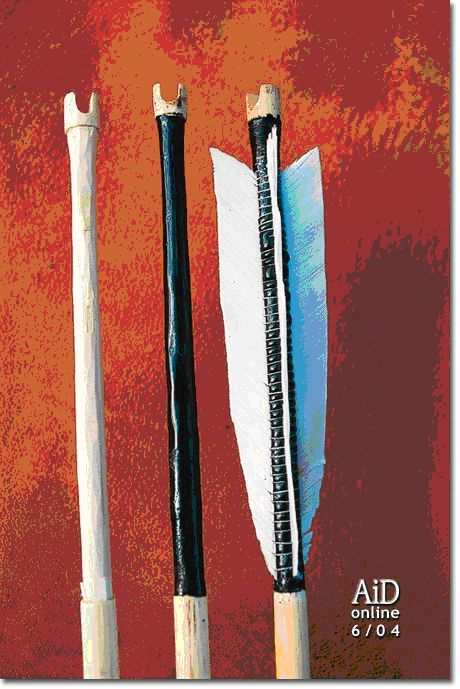
The fletching of the arrows was made from the feathers of birds of various sizes. In total, fletching made from the feathers of 9 species of birds was found (e.g. goose, swan, eagle, etc.). The fletchings were attached to the arrow by gluing (birch tar) and by binding (bast, 22 to 76 turns per 10 cm). Arrows used 4 fletchings glued in an X shape or a cross shape. The length of the fletchings ranges between 8 and 13 cm. The nocks of the arrows are widened and the nock for the bowstring is cut in a U or V shape. The depth and width of the nock is at most 0.5 x 0.5 cm.
In conclusion, I would like to ask the archery community for help in finding further sources on these bows. Specifically, this concerns a book (or articles) by Ole Nielsen.
Sources used:
- Bögen und Pfeile in Der Opferplatz von Nydam by Harm Paulsen
- Internet
Author: O. Fröhlich (Iwaz)
Photo documentation:
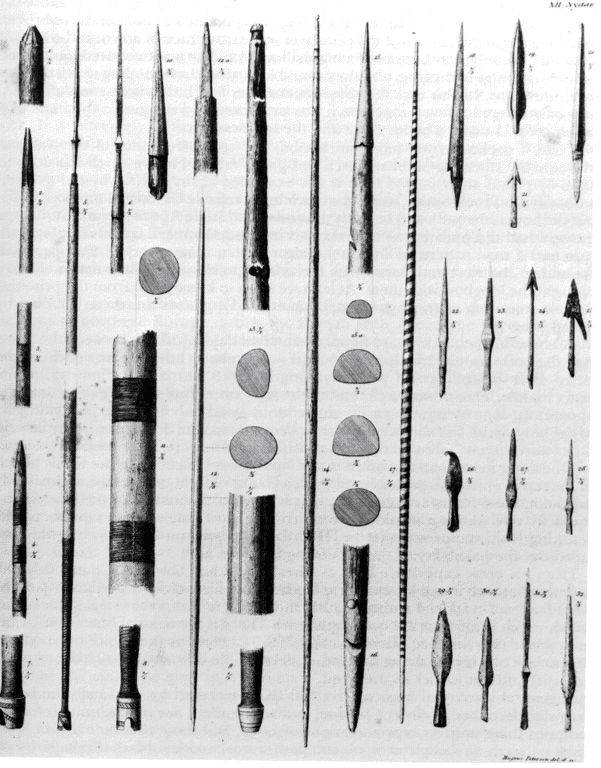 (Engelhardt 1865, plate 12 bows, arrows and points from Nydam) 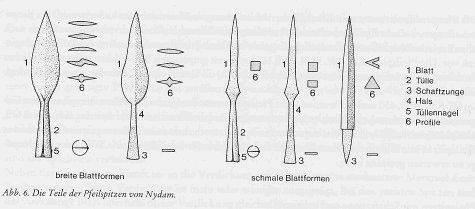
Fig. no. 1: parts of points from Nydam (Paulsen Harm 1998, Fig. 6) 1) blade 2) socket 3) tang 4) neck 5) socket rivet 6) profiles |
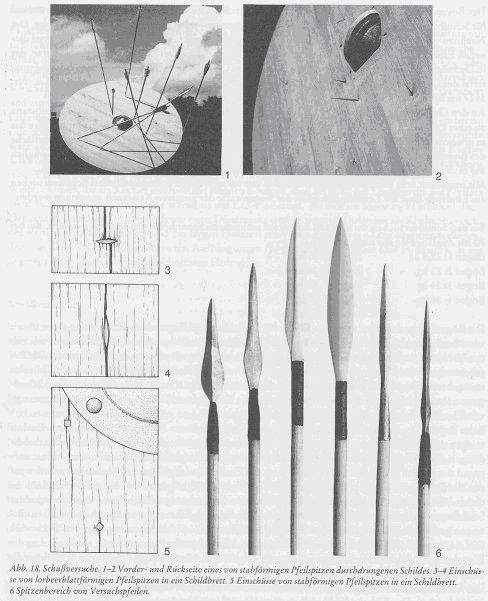
Fig. no. 2: Shooting tests. 1-2: front and back of a shield pierced by thin points. 3-4: piercing of a shield by a laurel-leaf-shaped point. 5: piercing of a shield by thin points. 6 shape of the points of the test arrows. (Harm Paulsen 1998, Fig. 18) |
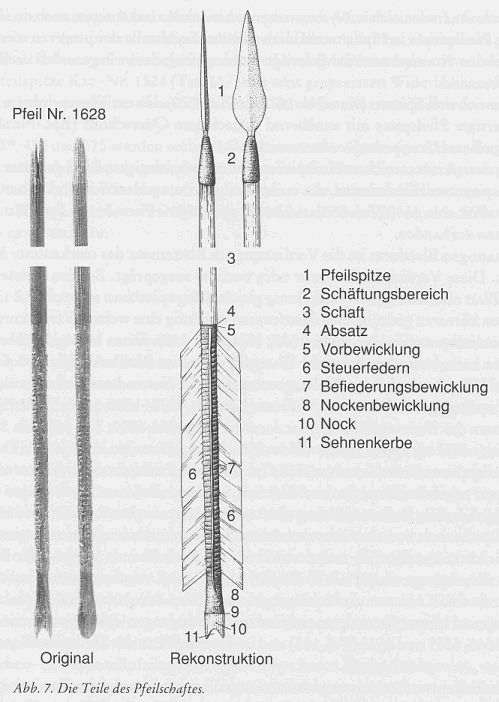
Fig. no. 3: Parts of arrows (Paulsen Harm 1998, Fig. 7) 1-arrow point, 2-part of the shaft (attachment of the point), 3-shaft, 4-projection, 5-front binding, 6-fletching, 7-binding of the fletching, 8-binding of the nock end, 10-nock end, 11–nock for the bowstring Arrow (catalogue number 1628): overall length 85 cm, diameters (from the point) a 0.78, b 0.88, 0.82, d 0.98 cm, length of fletching 13.15 m, V-shaped nock for the bowstring, pine wood |
|