Bows from Haithabu
Machine translation.
This page was machine-translated from Czech. The Czech version is authoritative.
Switch to original Czech version. · Zobrazit originál článku v češtině
These finds provided enough information material for us to create an almost complete picture of this weapon from the time of the Vikings.
The article was sent to us by O. Fröhlich (Iwaz).
Description of the bows found
Bow No. 1
Figure 1 shows a longbow made of yew wood, 191 cm in length. The bow has an oval cross-section along its entire length. The middle of the bow is 4 cm wide and 3.3 cm high, and its ends are slightly narrowed. Owing to the shrinkage of the sapwood on its back, the bow now has a slight reflex.
Unlike today's sport bows, the ends of the bow limbs found in Haithabu are slightly bent towards the archer (from 9 cm on the upper end and from 7 cm on the lower one). The fan-shaped end of the limb with an oval cross-section (upper: 3.0 x 2.3 cm and lower 2.8 x 1.5 cm) changes into a D-shape towards the middle of the bow. Signs of shallow nocks are visible at both ends of the bow. At a distance of 7 cm from the end of the upper bow limb there is a straight, rectangular nock for the bowstring, 4 mm deep. The profile of the nock is sharp and gives the impression of short-term use, see Fig. 4.
At a distance of 17 cm below the end of the upper bow limb, a small nail with a half-round head has been driven into the middle of the back of the bow. An X-ray image showed that the nail has been driven 0.7 cm deep into the sapwood. From the distance of the nail from the end, the length of the unstrung bowstring can be inferred.
The place where the bowstring was probably tied is indicated by a shallow narrowing on the lower bow limb. A small protrusion prevents the bowstring from slipping towards the middle of the bow. Movement of the bowstring backwards is in turn prevented by the widened end of the bow. The imprint of the bowstring at both ends of the bow is not very noticeable. In the middle of the bow, scratches from an arrow that moved along its side during the shot are also visible.
The bow is made from an extremely thin yew stem, which may have had a diameter of only 5–6 cm at the roots. The sap channel is found along almost the entire length of the bow. The bow was positioned in the yew trunk so that its upper limb was oriented towards the roots. The belly of the bow is ground very smooth. By contrast, its back is bumpy and knotty, and was left almost unchanged. Aesthetic considerations gave way here to functionality. On the back of the bow only the bark was removed, and the knots left by small branches were only lightly smoothed. The knots in no way impair the function of the bow.
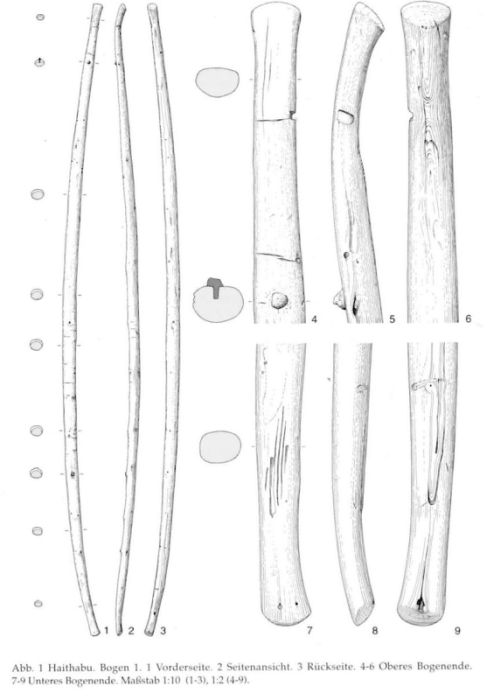 Fig. 1: Bow No. 1 |
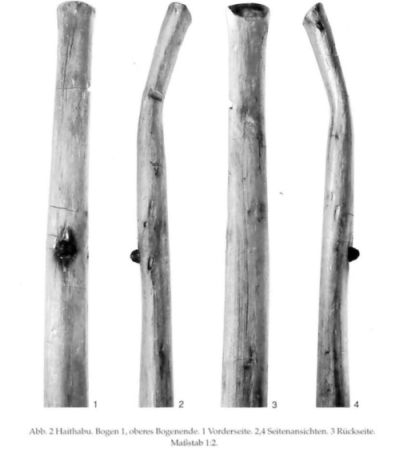 Fig. 2: Bow No. 1 |
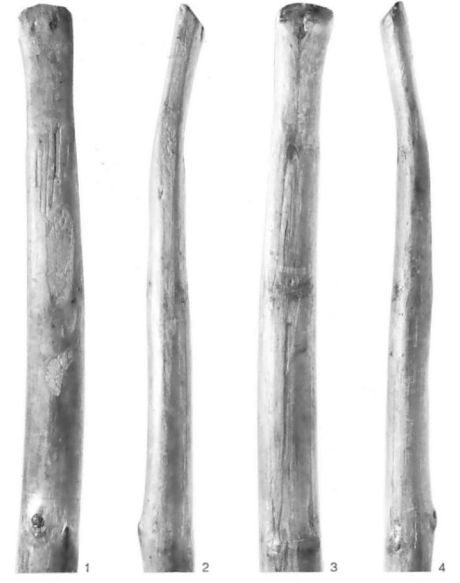 Fig. 3: Bow No. 1 |
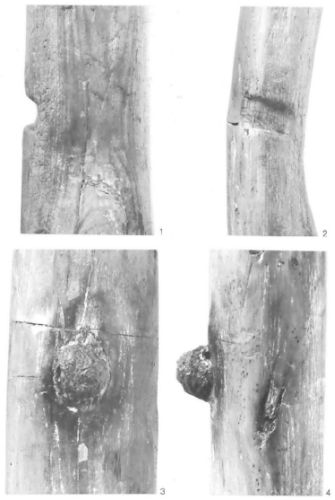 Fig. 4: Bow No. 1 |
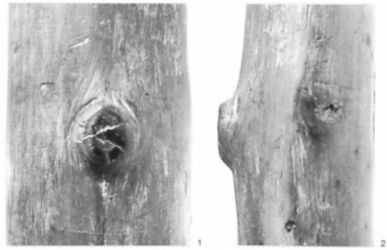 Fig. 5: Bow No. 1 Bow No. 2 Only the broken upper end of the bow, 16.3 cm long, has survived to the present day (Fig. 6). The bow, which has an oval profile along its entire length, was made of yew and has a diameter of 2 x 1.4 cm at the break. From the surviving remnant of the bow it can be seen that its end was cut several times with a sharp object and broken off. On its side, at a distance of 5.8 cm from the end, a distinct bowstring nock 5 mm wide and 4.5 mm deep has been cut, on which a distinct imprint of the bowstring can be seen. This bow, too, is made from a very thin yew stem, the wood of which was ground very carefully. On the belly side of the bow, near the break, traces of the sap channel are visible. The stem was only a few centimetres thick at this point. The end of the bow is slightly bent backwards and has an oval cross-section measuring 1.6 x 0.9 cm. A low ridge has been lightly ground at the end of the bow. |
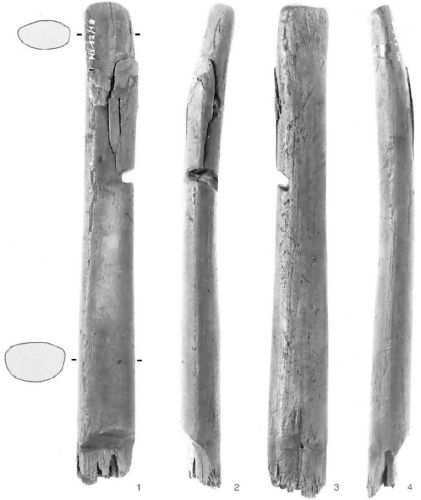 Fig. 6: Bow No. 2 |
Bow No. 3
This is a fragment of the lower end of a bow, which was also made of yew wood. Only 47.5 cm of the bow has survived, and the diameter at the break is 2.4 x 1.6 cm. The transition into the bend of the bow lies 3.5 cm from the end, where a trace of pressure from a binding is clearly visible. These are probably traces of where the bowstring was tied. On the oval end of the bow (cross-section 1.4 x 0.8 cm) a ridge similar to that on Bow No. 2 can be seen. The function of this ridge is unknown. The belly of the bow is again carefully worked. On the back there are two prominent knots. Judging by the thickness of this fragment, the stem was only 4 cm thick.
Bow No. 4
Figure 7 shows a fragment of the lower end of a yew bow, which has survived to a length of 27.8 cm. The bow also has an oval cross-section, measuring 2.6 x 1.9 cm above the break. The end of the bow, 8 cm long, is slightly bent backwards. The oval end of the bow has a diameter of 2.2 x 1.1 cm. The diameter of the stem at the break was at most 4–5 cm. A free sap channel can be seen on the belly, and the back of the bow is free of knots. The fragment is very carefully ground.
Bow No. 5
This is a fragment of the lower end of a bow made of yew wood, which has survived to a length of 23.1 cm. The cross-section of the bow at the break is 2.1 x 1.5 cm. The end of the limb is 6.7 cm long and is bent backwards. At this point the width of the bow is also narrowed to 1.5 cm to prevent the bowstring from shifting backwards. The end of the bow has a D-shaped cross-section measuring 1.7 x 0.8 cm.
Bow No. 6
This is the end of the lower limb of a yew bow with an oval cross-section, surviving to a length of 21.8 cm and 1.9 cm wide at the break. On the oval end of the limb (cross-section 1.2 x 0.8 cm) a small ridge has been formed, as on bow fragments Nos. 2 and 3.
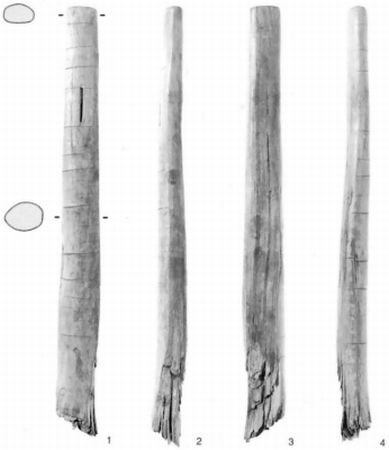 Fig. 7: Bow No. 4 Bow No. 7 This is the upper end of a bow made of elm wood (Fig. 8). The surviving length of the bow is 37.5 cm. Above the break the bow has an oval cross-section measuring 2.7 x 1.65 cm. The end of the limb has a cross-section of 1.9 x 0.85 cm. |
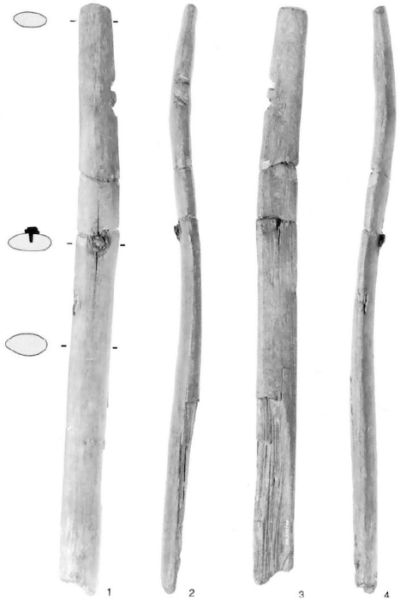 Fig. 8: Bow No. 7 |
Comparative analysis
When we compare the completely preserved bow and the six bow fragments with one another, we find that they are identical only in details. The bows differ from one another above all in strength. Next to the massive Bow No. 1, Bows No. 2 and No. 3 seem rather slight. All the bows are made from very thin stems of yew and elm, which is why their backs are strongly rounded.
The number of growth rings discernible on their surface varies. To determine their number exactly, the bow would have to be cut through, but given the importance of the find, this destructive step had to be forgone. The number of years was therefore judged only from a surface examination of these bows. On the yew bows an average of 12 to 15 growth rings per 1 cm were counted, and on the elm bow 5 to 6 years per 1 cm.
To assess the strength of the profile of the bows found, the shrinkage caused by the drying and conservation of the material from which they were made had to be taken into account.
The ends of the bows are slightly bent on Bows No. 2, 4 and 6, and strongly bent on the others. This bend is a striking feature of the bows found in Haithabu. We assume that a fixed bowstring was usually used with this type of bow, because there was a firm binding on the lower limb. A bowstring nail for an unstrung bowstring is not unusual and is found, for example, on bows found at Nydam [2].
Archaeological research carried out in the Nordic countries has brought, among other things, finds of other bows similar to those from Haithabu.
An almost complete bow from the Viking Age was found, together with a 10th-century sword, for example in a house at Ballindery in Ireland. The bow is 185 cm long, with a middle cross-section measuring 3.8 cm in width and 2.86 cm in depth. The bow narrows slightly towards the ends and its cross-section has the shape of a rounded quadrilateral passing into an oval. One end of the bow is clearly bent backwards, but the other end is heavily weathered. Just like the bow from Haithabu, this specimen from Ireland is slightly bent forwards (i.e. it has a slight reflex). A small hole at the weathered end of the bow was probably a nock for the bowstring.
Another fragment of a bow made of yew, 40.1 cm long, was found at the Slavic hillfort of Oldenburg in eastern Holstein [4]. As in Haithabu, a peculiarity of this broken bow limb is the variable attachment of the bowstring. At the end of the bow limb there are four nocks arranged in pairs one above the other. The nocks lie 4.2 to 6.0 cm from the end of the bow. K. Beckhoff estimates the original length of the bow at 199 cm and the draw weight at 22 kg. Beckhoff concludes that bowstrings made of animal materials, such as gut or sinew, were predominantly used with these bows. A bowstring twisted from such materials lengthens in damp conditions, and the upper nocks were therefore used to maintain the same draw weight. By contrast, bowstrings made of plant materials, such as flax or hemp, hardly change their length in damp or dry conditions, and so a single nock was sufficient on the bow.
Another possible explanation for the different bracing height (even for the three bows from Nydam, which are also equipped with graduated nocks) can be found in Roger Ascham, the famous English archer, who in 1545 recommended two bracing heights for English longbows. A low one for shooting at distant targets, and one two inches higher for targets close by. In these cases, however, the different height was achieved not by graduated nocks but by using bowstrings of different lengths [5].
Other depictions of Viking bows
Other depictions of bows similar to those from Haithabu can be found, for example, on a runestone found in Uppland [6]. The stone shows a hunting scene of an archer with a pointed beard travelling on skis. Despite the crude execution of the drawing, the clearly backward-bent ends of the limbs of the depicted bow can be seen. It is possible that this is a depiction of the Viking god Ullr, whose attributes include a bow and arrows.
Another depiction of a Viking bow can be found in an English church chronicle of the 11th century (owned by the Piermont Morgan Library), which also contains a description of the murder of King Edmund by Ivar's Vikings, who shot him with arrows. In this chronicle the bows depicted correspond entirely to the bows from Haithabu described above, above all in the backward-bent tips of the bows, which widen above the attached bowstring. The bows have only one nock for the bowstring, with the loop of the bowstring hung in it. On the lower limb the bowstring is tied; the position of the nock and the tying of the bowstring are identical to the findings made on the bows found in Haithabu, see [7].
Haithabu (Danish Hedeby, Latin Heidiba, German name Haddeby).
You can read more about this area on Wikipedia http://en.wikipedia.org/wiki/Hedeby (in English).
You can also visit the website of the Viking museum in Haithabu. (in English).
Author: O. Fröhlich (Iwaz)
E-mail: rethel@seznam.cz
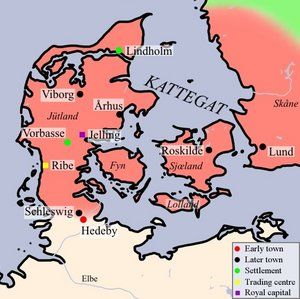 Map of Denmark and the location of Hedeby Sources used: [1] Harm Paulsen, Bogen und Pfeile in Haithabu, Bericht 33, Das Bogenbauerbuch [2] Engelhart 1865, Tab. No. 12.6, Paulsen 1998, p. 394 [3] Clark 1963, p. 87, Fig. No. 21.5 [4] Beckhoff, 1991 [5] Schöter 1983 p. 148f [6] Stenberger 1977, Fig. No. 34 [7] Raunsing 1967, Fig. No. 23 b-c [8] internet |
|