Flemish Laid Bowstring
Machine translation.
This page was machine-translated from Czech. The Czech version is authoritative.
Switch to original Czech version. · Zobrazit originál článku v češtině
A traditional bow undoubtedly deserves a traditional bowstring.
The Flemish string (Czech: vlámská ložená tětiva), finished on one side with a woven loop and on the other with an archer's knot, and otherwise "loosely laid" along its whole
length, is a beautiful example of the skill and ingenuity of our ancestors.
Yet few people know how to make a nice Flemish string. One of those who really can, and who tries to pass it on to his students at his seminars as well, is the bowyer Jarda Petřina,
known in the local community as Hawkwind. In the following lines I will try to
prove that I was a sufficiently attentive student of Jarda's, and to initiate you into the secrets of
making a Flemish laid bowstring. Preparation
First, what you will need for making it:
- material for the bowstring
- beeswax
- a sharp knife
- a wooden board
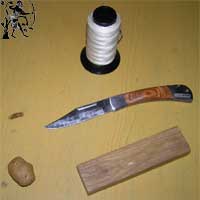
The material can be either natural, if we want a truly authentic bowstring, or modern, if we do not insist so much on authenticity.
Among natural materials it is possible to use tightly twisted linen thread, silk, or perhaps raw hemp stiffened with glue.
However, traditional materials are somewhat harder to work with and do not usually last as long as modern synthetic materials.
Among modern synthetic materials, Dacron B-50 is used above all. This polyester fibre, with a stretch of about 2.6%, is particularly suitable because there is less shock when the arrow is released, so traditional bows do not suffer as much. Materials with less stretch, such as Fastflight (stretch 1%), are for this reason not suitable for traditional bows. An all-wood bow with a Fastflight bowstring is unlikely to last you very long.
The manufacturer gives the strength of Dacron B-50 fibre as 50 pounds, i.e. 22.7 kg. This is, however, rather a theoretical value; in practical tests the Dacron fibre broke at around 13 kg.
Dacron is also sold waxed or unwaxed. For the purposes of a Flemish string, unwaxed is more suitable – we wax what we need ourselves, and the unwaxed strands at least do not stick together where that is undesirable, so unwaxed Dacron is easier to work with.
The number of fibres from which you will make the bowstring depends on the draw weight of the bow it is intended for. The bowstring is braided from three equally thick strands, so the number of fibres will always be a multiple of three. The bowstring should be dimensioned for approximately four times the draw weight of the bow, so if, for example, you are making a bowstring for a 40 lbs bow, it should be able to bear a weight of 160 pounds (I remind you that one pound is approximately 454 grams). It is therefore necessary to find out the load capacity of a single fibre and thus determine the minimum number of fibres for the given draw weight of the bow.
For Dacron B-50 the following table applies approximately:
| Bow weight (lbs) | < 40 | 40 - 60 | 60 - 80 | 80 - 100 | ... |
| Number of fibres | 12 | 15 | 18 | 21 | ... |
Procedure
(Click on the photographs to view the picture in a higher resolution.)
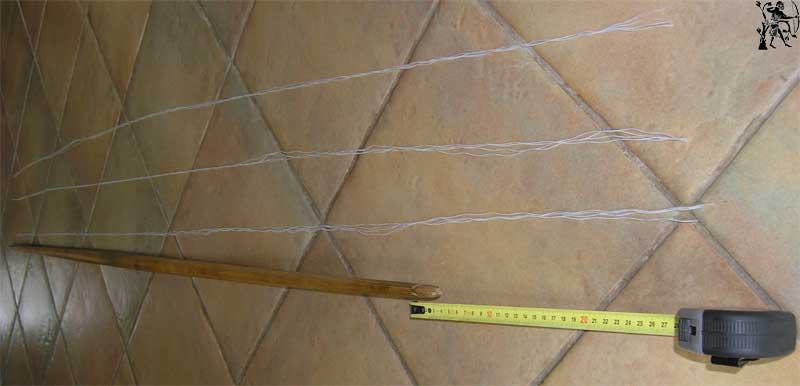
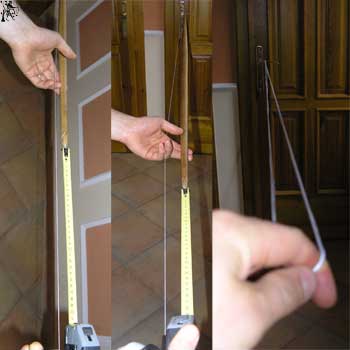
- We unwind from the spool and cut the required number of fibres. The fibres will be as long as the bow when unstrung + about 30 cm extra.
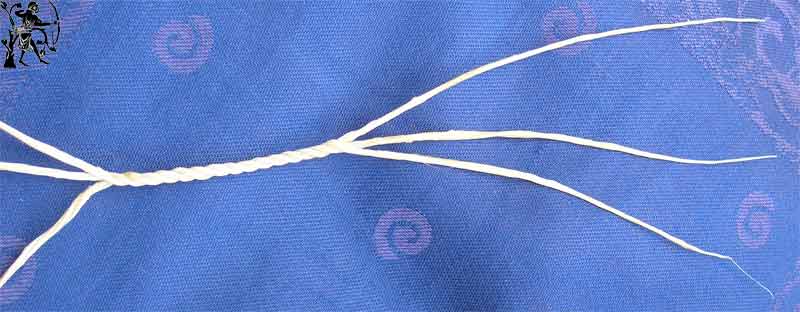
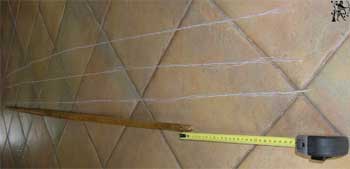
- We divide all the fibres into 3 equal strands.
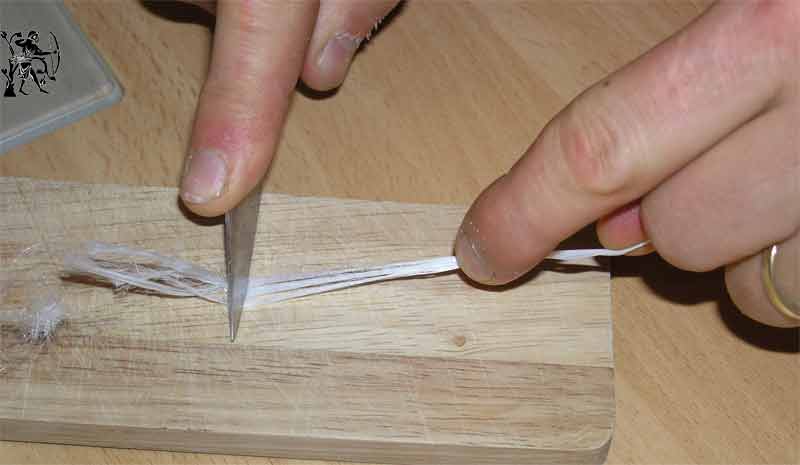
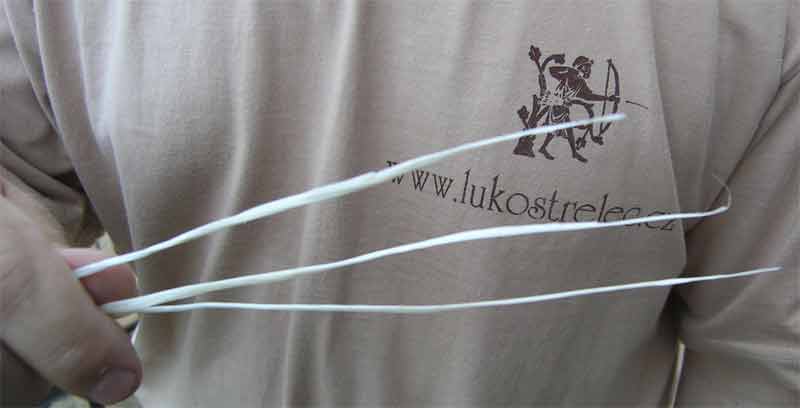
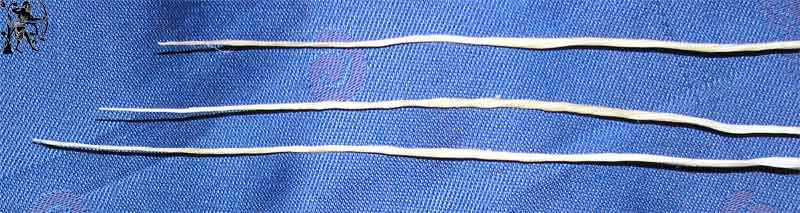
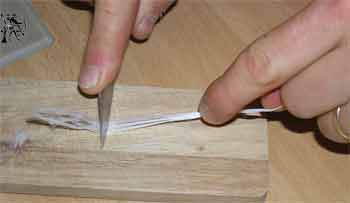
- Using a sharp knife on the board, we "shave" one end of each strand so that it tapers off to nothing over the last 5 - 7 cm.
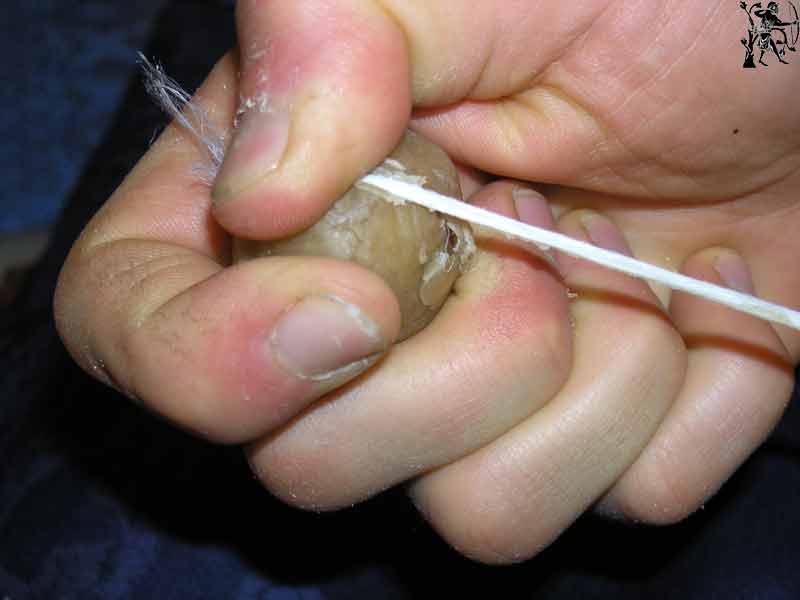
- We wax the end prepared in this way thoroughly with beeswax, so that a point forms at the end of the strand.
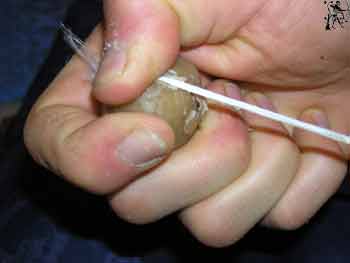

- We wax the last 25 - 30 cm of the strand. A well-waxed strand should be able to stand upright.
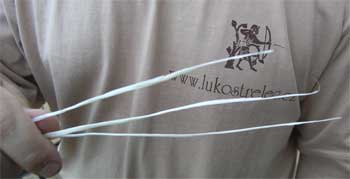
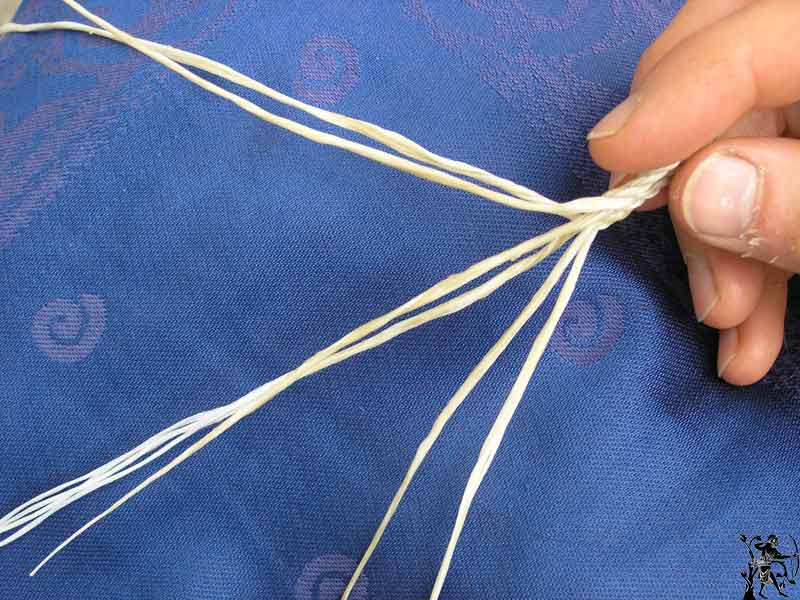
- I arrange the strands side by side between my fingers so that each following strand always ends 1 - 2 cm earlier than the previous one.
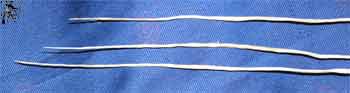
- I hold the strands about 20 cm from the end of the longest of them.
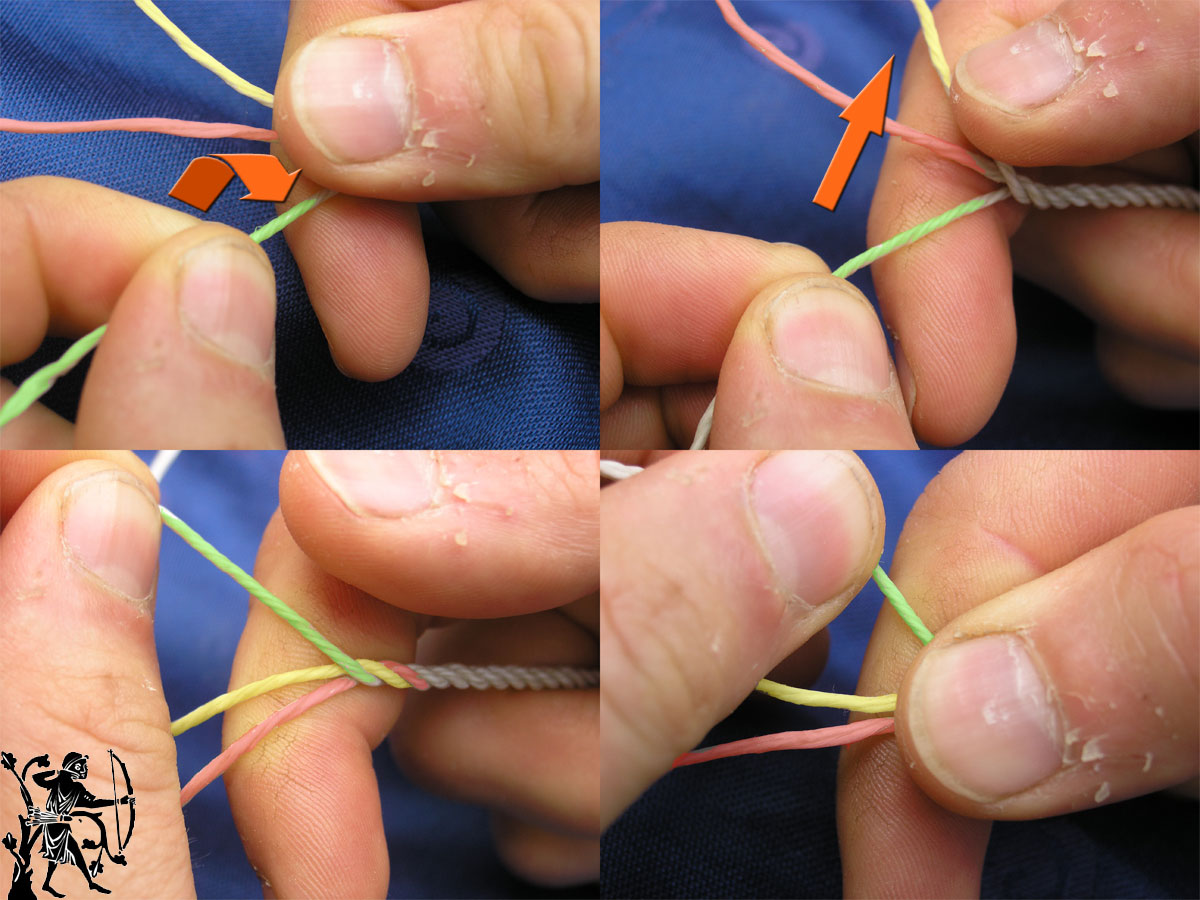
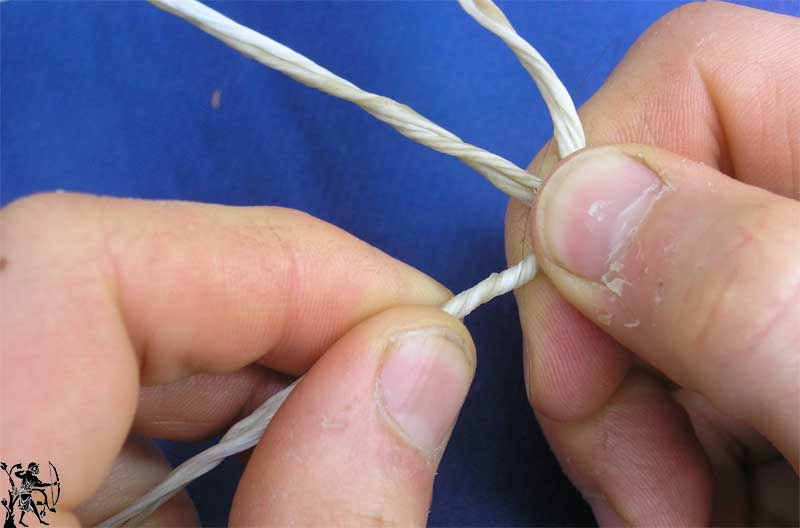
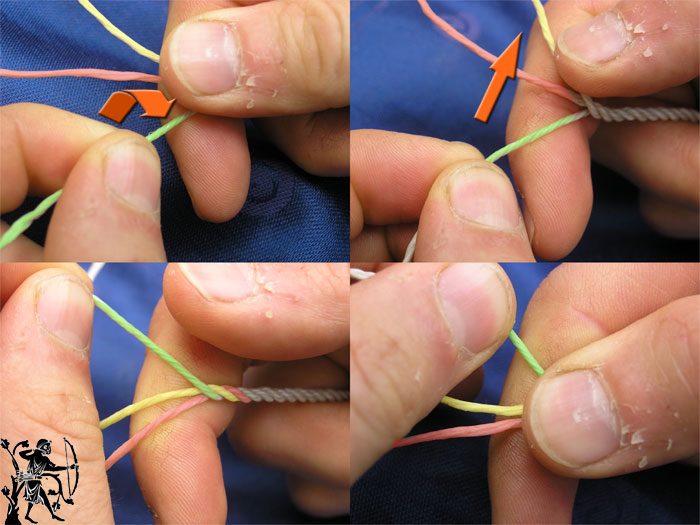
- We hold the bowstring in the right hand between the ball of the thumb and the first joint of the index finger and begin to braid a simple plait towards the waxed end of the strands. We proceed as follows:
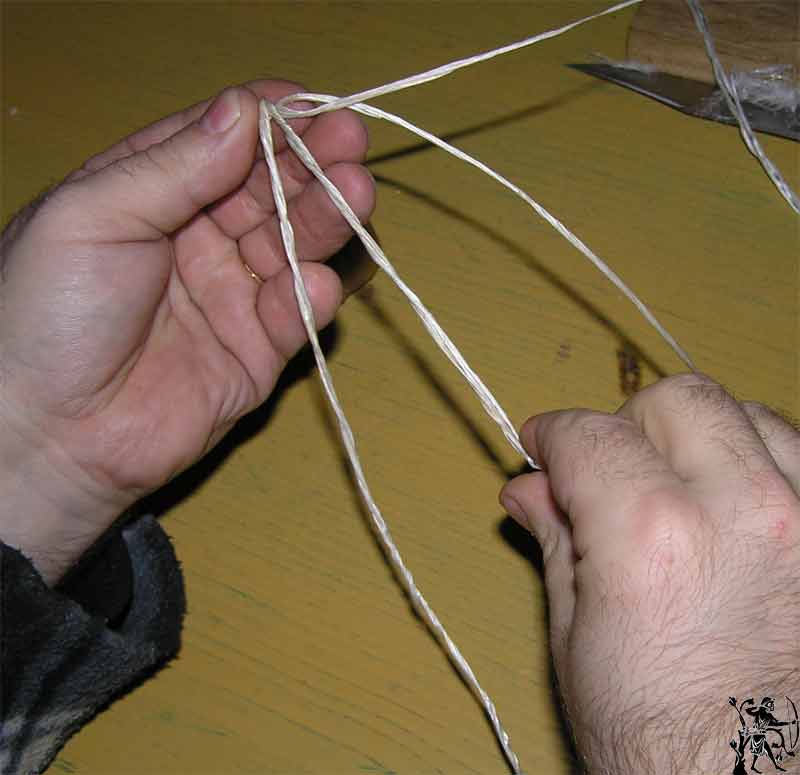
- We take the leftmost strand about 1 cm from the place where I am gripping the bowstring with my right hand.
- We twist the strand firmly between the index finger and thumb of the left hand away from the remaining two strands.
- We fold the twisted strand to the right under the thumb over the other strands.
- We tighten the forming plait and straighten all three strands between the fingers back into the starting position.
- We repeat the procedure with the strand that is now furthest to the left.
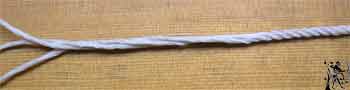
- If we do not proceed correctly and twist in the opposite direction, it will look similar to the picture below. On the right is a properly braided plait; on the left you can see the "plait" created by twisting in the opposite direction to the desired one.
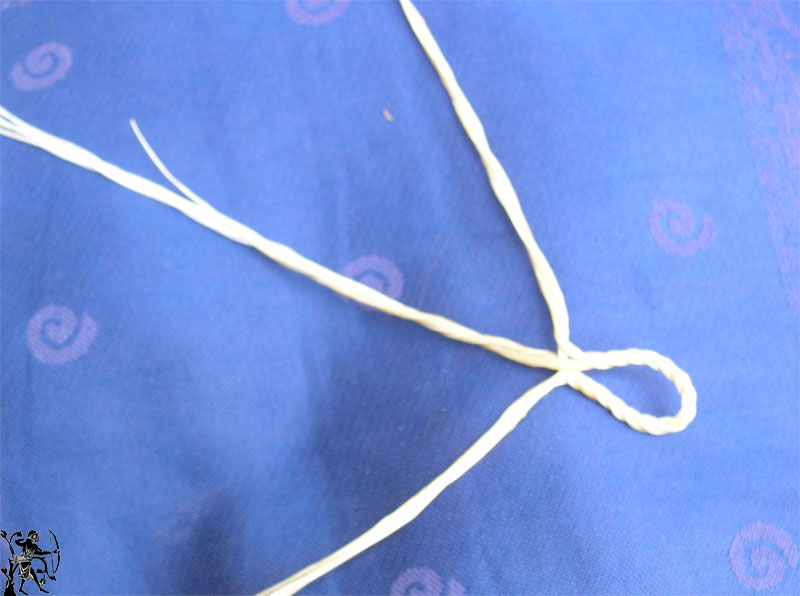
- In the manner described we braid a plait of about 6 cm. This plait will form the loop of the bowstring, so its length depends on how large a loop we need on the bow.
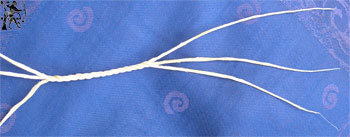
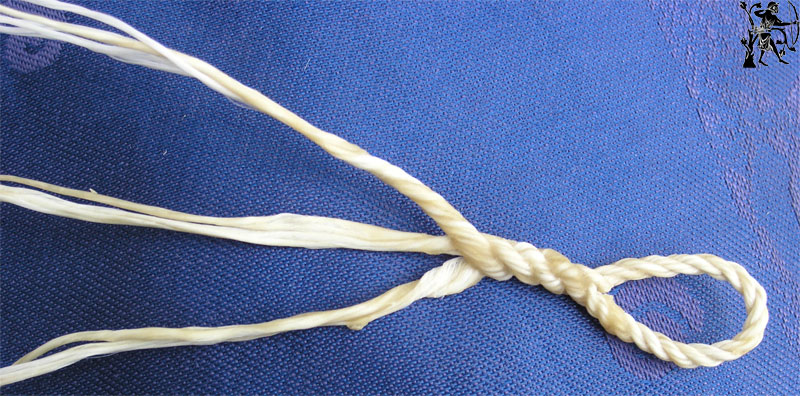
- Once we have braided a plait long enough to form the loop, we will braid in the end of the bowstring. First we fold over the end of the bowstring so as to create the aforementioned loop.
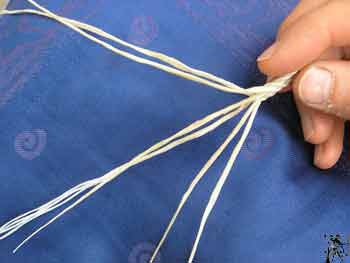
- We place the corresponding strands from both ends of the plait together and twist them lightly into one another in the same direction in which we will then do the braiding.
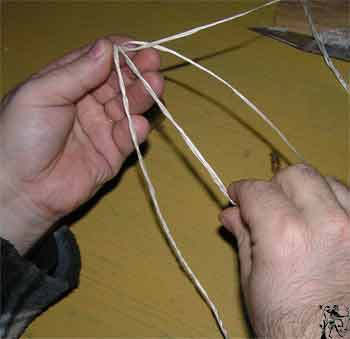
- Again we arrange the strands between the fingers; from now on we treat the doubled strands as a single strand of fibres.
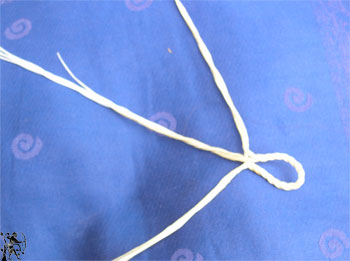
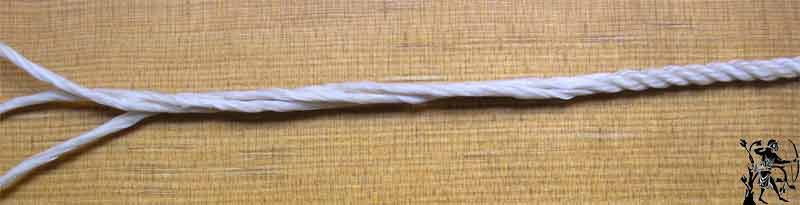
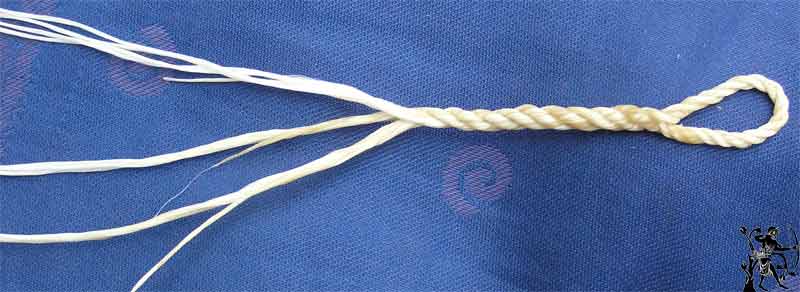
- We continue twisting the plait, but now towards the opposite (long) end of the bowstring.
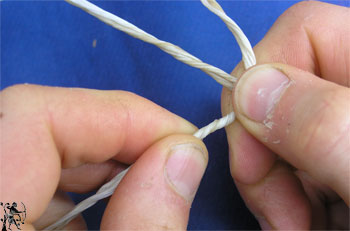
- Because the ends of the strands were offset by 1 - 2 cm, the plait of the bowstring will gradually thin down to the thickness of 3 single strands.
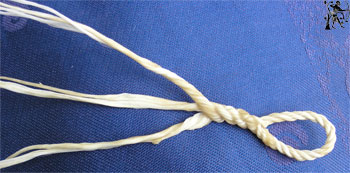
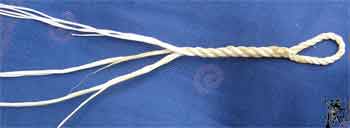
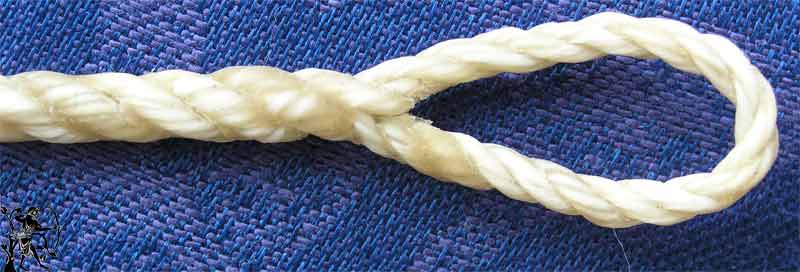
- We braid the plait until we have braided in the last doubled strand as well. We add another centimetre or two and we are finished with this end of the bowstring. We have successfully got the harder part behind us.

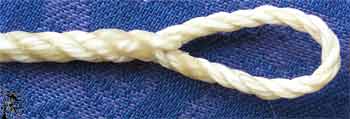
- Now we twist the whole bowstring lightly and smooth it along its entire length so that, when gripped at the opposite end, all the strands are the same length. If one strand were shorter than the others, it would bear the whole load and the bowstring would not last long.
- We wax the last 20 cm or so of the bowstring as in step 5 and again braid a plait according to step 7.
- We braid the bowstring to the very end and make a small knot at the very end. If we are using Dacron, we can "seal" the end with a lighter.
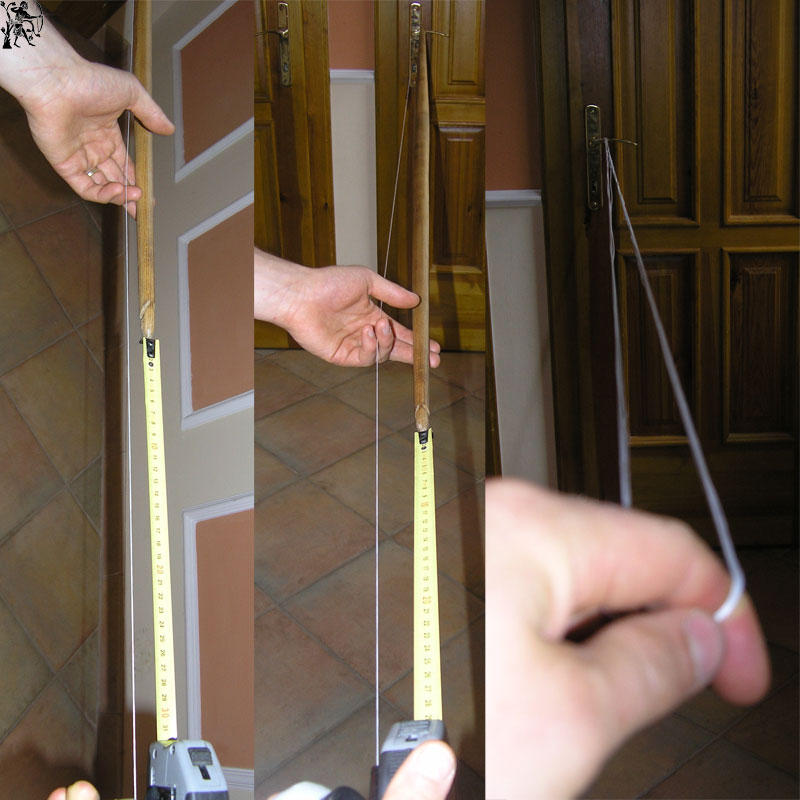
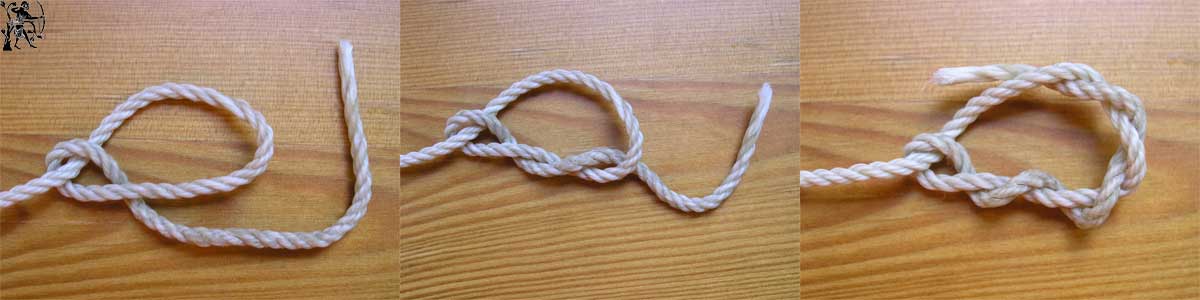
- The bowstring is finished and all that remains is to adjust it to the length of the bow. We have the finished loop at one end, so at the other end we make an "archer's knot" (also called a "timber hitch", which is another name for the same knot) so that the space between the bowstring and the belly of the bow at the nocking point is about 10% of the length of the bow, so for a 180 cm long bow the height will be around 18 cm.
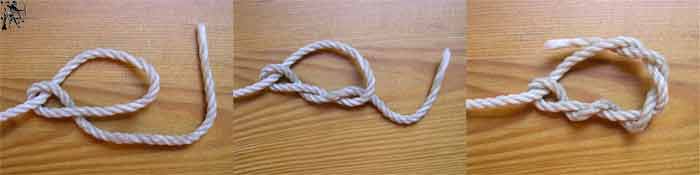
- In the simplest case, we can just wax the place for the arrow nock well with beeswax and mark it off with thread. In that case, however, it needs to be waxed regularly, and we must expect that even so the bowstring will not last long at this spot and will wear and subsequently fray there.
- In the better (but more laborious) case, we also wrap the centre of the bowstring over a sufficient width with a serving that protects the fibres of the bowstring.