Part 3: Archery in Medieval Europe
Machine translation.
This page was machine-translated from Czech. The Czech version is authoritative.
Switch to original Czech version. · Zobrazit originál článku v češtině
The original text of the History of Archery was compiled from various sources by the successful sport shooter Mr Jaroslav Dřízal. With the author's consent, we are presenting it to you as a series in several parts, where each part maps a certain defined stage of historical development. We do not claim that the texts are exhaustive. Even at this length, they cannot be. But perhaps you yourself have historically documented information relating to the period in question that could interest other readers. So become a co-author. Join us and send us your contribution or comment. In this way you will help us create a comprehensive work that follows the development of archery from its beginnings to the present day. A work that will speak to us across the abyss of time.
Thank you
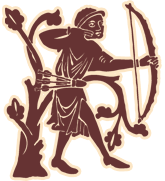
In the Middle Ages, up to the 16th century, archery flourished in Europe on a large scale. The Saxons were outstanding makers of bows. The Britons lost the decisive battles to the Saxons precisely because of the excellent shooting of their archers. The Saxons' bows were of unremarkable appearance, made of elm, but very strong and powerful at shorter distances. It is said that the name "Scot" derives from the Old English "Scily", which meant archer. English bows were considerably long, and their origin is attributed to the warlike Normans and Vikings, who, by forceful shooting with bows under the leadership of their commander, William the Conqueror, decided a whole series of battles. The legendary archer of the Middle Ages was the English outlaw Robin Hood, who was admired even by his enemies. His home was Sherwood Forest, and he outlived King Henry II, Richard the Lionheart, John Lackland and Henry III. In Kirklees Priory there is still a grave bearing the true name of this outlaw, Robert, Earl of Huntingdon. According to legend, before his death he shot a last arrow from the window with the wish to be buried where the arrow landed. The English writer W. Scott describes Robin's skill in shooting in the novel Ivanhoe. There are, however, also scholarly arguments that Robin Hood never existed at all.
The English used the bow more than other nations, and their archers also decided several great battles (the Battle of Crécy). Archers at that time fulfilled the role of a kind of "archery preparation", that is, their aim was to throw the enemy's ranks into as much disorder as possible. Few could withstand volleys of arrows falling from a height with considerable penetrating power, often behind protective shields. In more modern times this function was taken over by artillery. The first known book describing the method of training in archery was also published in England. It was printed during the reign of Henry VIII, and its author, Roger Ascham, was rewarded with an annual pension of 10 pounds. At this time, by order of the sovereign, it was the duty of every citizen to practise shooting with the bow. Even in the years when most European countries were already using pistols, for example in naval battles, in fighting at shorter range, English sailors fought with bows and arrows.
Guilds of bowyers were very numerous in the Middle Ages, and their members were respected citizens in all countries for their skill in making bows and arrows.
Our territory, Bohemia, was inhabited in ancient times by various tribes of differing cultural levels. Among the cultured tribes were above all the Celts (already in the 8th century BC on the territory of present-day Austria), who came from the west around 600 BC. They inhabited our lands as far as the River Drava. Archaeological finds from this period confirm the use of the bow by these people through a number of finds of arrow points and sandstone bowstring straighteners. Simple bows were made, of maple or yew wood. Besides bowstring straighteners, arm guards made of slate or lydite have also been found. The Celts on our territory lived in the times of the greatest flourishing and the fall of the Assyrians in Asia Minor.
After that there is a considerable gap in time, which includes the Slavic settlement of our territory and the beginnings of Christianity. Bows and arrows, however, were certainly still being used here.
In the Middle Ages the bow and arrow became a necessary part of the equipment of military units. Numerous archery detachments were formed, whose prowess decided battles. The best archers were selected for the royal military units. During the reign of King Charles IV, the Prague archers were given their shooting range beneath the city walls near today's Powder Gate. Besides Charles IV, archery was also favoured by John of Luxembourg (who fell at the Battle of Crécy, which the English won thanks to the better shooting of their archers), the Jagiellons and Rudolf II. Under Charles IV archery became an exercise for everyone. Archers received considerable direct support from Charles IV himself and from the Prague city councillors and a whole series of Bohemian and Moravian towns. Shooting competitions were held, culminating in archery festivals at Whitsun. All strata of the population took part in archery. Bohemian and Moravian towns competed with one another in archery. The most numerous archery corps was that of the Prague archers.
The development and popularity of archery spread to such an extent that shooting took place in all the gardens of Prague, and archery became a dangerous pastime. For this reason, river islands were permanently allocated to archers in order to prevent the danger of frequent injuries. This was today's Štvanice (Little Venice and Shooters' Island). The tradition of archery on Shooters' Island is maintained, at least during winter training, by the archery section of SK Start Praha.
The Hussites also had numerous archery detachments. In Hussite times, however, bows, crossbows and the first lighter firearms (hook guns and pipes) were already being used side by side. In the period after the Battle of White Mountain (16th century) the archery corps disappeared, and the numerous makers of bows, arrows and quivers vanished as well, because the Thirty Years' War and the Jesuit darkness suppressed the noble idea and the martial character of old Czech archery almost entirely. One of the last mentions of archers is in Jirásek's F. L. Věk, which tells of a review of General Suvorov's army on the Karlín field before the campaign to France, where the units of Tatars with bows were admired. In later times the bow gave way to the crossbow and firearms.
A word from the author
The basis of this essay was the introduction of the same title from the Handbook for Coaches II and III, compiled in 1985 by Jaroslav Holub and a team, which in turn took over information from the publication Archery, a Handbook for the Training of Class II Coaches of 1963, compiled by a team led by Vlasta Kaplanová. The sources drawn upon are not given in the handbook. It is possible that the chronology of the individual examples is not perfect. Conclusions and an illustration from C. W. Ceram's book The First American were also used, together with information from the brochure Problems of Archery, Part 1, which was apparently translated from English at some point within the ČLS; its US origin, year of publication and author are not stated. When comparing some passages of this book and the book The First American, it is clear that they draw on the same American sources. Some ancient dates were taken from the chronological table given in the preface to the Old Testament.