The Late Gothic Crossbow and Its Construction
Machine translation.
This page was machine-translated from Czech. The Czech version is authoritative.
Switch to original Czech version. · Zobrazit originál článku v češtině
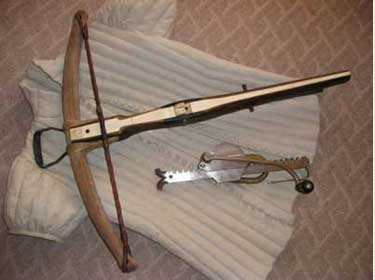
The crossbow, i.e. a mechanical missile weapon with a massive bow (prod) mounted transversely on a stock and a simple trigger mechanism, underwent a very long development, and its beginnings can be traced back as far as c. 400 years BC in Greece and China. This article covers only a relatively short period of its history, when it played an important role in all the conflicts that affected our territory.From the beginning of the 15th century, the crossbow was…
Bows are not the only thing you can shoot with, and there are also quite a lot of crossbowmen in the Czech regions. The following article is intended precisely for fans of this more modern weapon. Its author is Martin "Broďan" Picek – the article is reproduced with the author's kind permission from the website of the Bratrstvo střelcuov miesta Český Brod (Brotherhood of Shooters of the Town of Český Brod), of which Broďan is a member.
Introduction
The crossbow, i.e. a mechanical missile weapon with a massive bow fixed crosswise to a stock (the tiller) and with a simple trigger mechanism, underwent a very long development, and its beginnings can be traced as far back as about 400 BC in Greece and China. This article describes only a relatively short stretch of its history, when it played an important role in all the conflicts that affected our territory. From the beginning of the 15th century the crossbow (in the language of the time "samostřiel" or "kušě") was essentially the only missile weapon used for military purposes in Bohemia, and the preference for it over the bow has to be seen in a wider context.
From the 11th century onwards, the most important component of a feudal army in Europe was the heavy cavalry of the nobility; the medium cavalry played a supplementary role and the infantry, with exceptions, a rather subordinate one. The proud and self-assured knight expected an equal opponent, with the same equipment and the same style of fighting. The tactic of clashing formations of armoured horsemen did not need to be changed in our region for several centuries.
The bow that was used here in the Middle Ages was not a particularly powerful weapon and, with the development of protective armour, it became ineffective. Gothic paintings show both recurve bows and straight bows (e.g. the Velislav Bible and the Bible of Wenceslas IV). Over the course of the 14th century a growing numerical superiority of crossbows over bows can be observed. By the beginning of the 15th century the bow was already a rather exceptional sight in military equipment. The crossbow clearly won out. It required no special training, was sufficiently effective even against armour, could be kept spanned for a long time and ready for instant shooting. Only a small space was needed to operate it, which was an advantage above all in the defence of fortifications.
It is generally known that the Hussite wars brought a fundamental turn in the way battles were fought. Inexperienced and initially poorly armed people's infantry would not have been a serious opponent for heavily armoured knights in the open field. It was able to hold its own only thanks to mobile field fortifications – the wagon fort. Since this was in essence a fortress, similar missile and firearms were used for its defence as in towns, castles and strongholds. The towns, which played a key role in the wars of that time, had sufficient craft capacity to equip the army with huge numbers of these weapons, which were demanding to produce. To each war wagon there were usually assigned 4–8 crossbowmen, 2 handgunners, 2 pavise bearers, several flailmen and polearm men, and 2 drivers. Mounted shooters were also often armed with crossbows (as an alternative to a firearm).
Construction
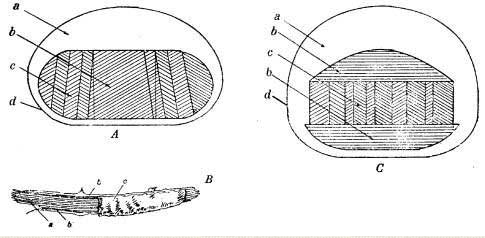
The late Gothic crossbow was a relatively perfected weapon. Its composite prod was made using various technologies. Usually several layers of animal sinew (which withstands tension well) were glued to the outer side of a wooden core and horn (which withstands compression well) to the inner side. The horn plates were grooved on both sides and glued to one another with glue. Fish glue was probably used, which is more flexible than bone or hide glue. The whole was covered with transversely joined hemp cords and wrapped in thin leather (parchment, snakeskin) or linen, or in birch bark. This outer layer was sometimes sewn shut, but sometimes merely glued.
Some prods lacked a wooden core entirely and consisted only of horn and sinew. In general it can be said that locally available materials were used to make prods, and production technologies therefore differed. In our region it is hard to assume that a standard prod contained, for example, whalebone.
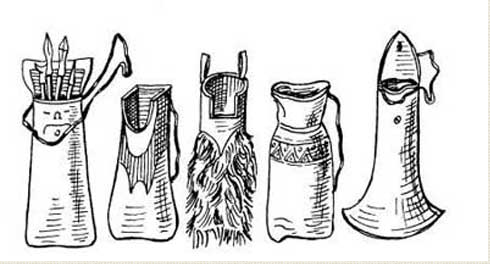
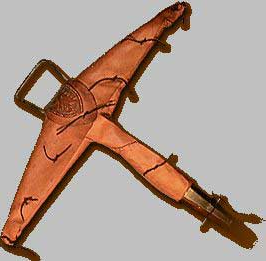
A prod constructed in this way was relatively light and therefore absorbed only a small part of the energy put into it in accelerating itself. In terms of the crossbow's efficiency it was thus more advantageous than the later steel prods. Its disadvantages were low resistance to rain and damp (special transport covers were used) and the long time needed to make it.
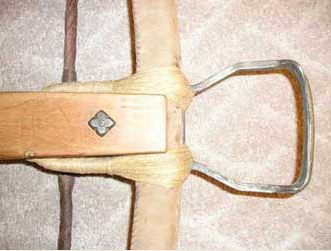
The composite prod was fixed to the tiller exclusively by a bundle of cords, usually hemp.
In western Europe the technology for making a steel prod had already been mastered in the 15th century. For it there was an alternative method of attachment using iron stirrups and wedges. In Bohemia the steel prod spread only in the 16th century, that is, in the Renaissance period.
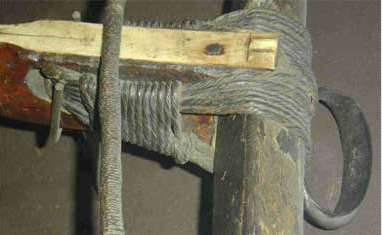
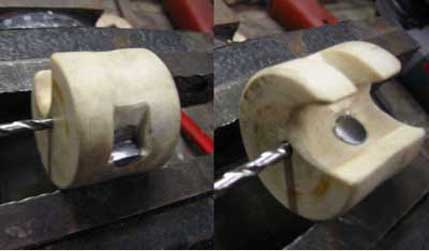
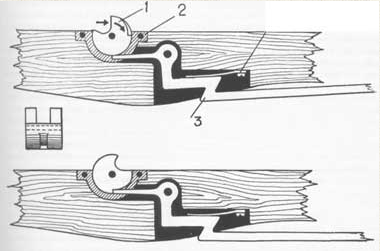
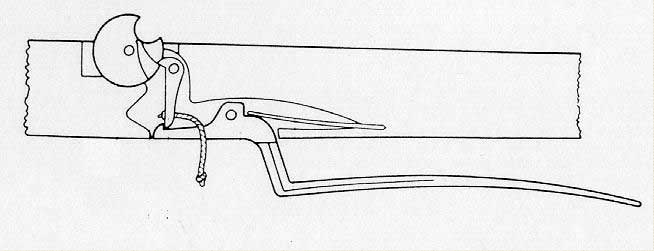
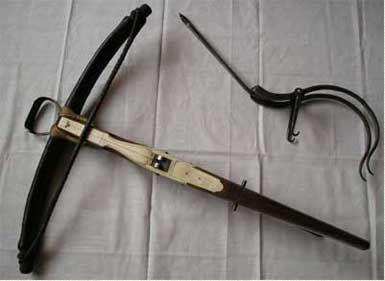
The strong bowstring was, once drawn, held by the so-called nut, which is a bone or iron roller with cut-outs for the bowstring and the bolt and with a notch for catching the trigger. The nut was precisely seated in the tiller, in a bed reinforced with bone or in an iron housing, against which it rested with its entire front surface when the weapon was spanned. It was therefore enough for it to be tied to the tiller with twine to hold it in place. Animal bone or antler was not a durable enough material for contact with the trigger lever. For this reason a vertical pin was fitted into the nut, holding an iron plate against which the trigger rested. Iron nuts were also used from the 15th century, yet a bone nut still commonly appears in the 16th and 17th centuries. An iron nut could also be attached to the tiller by a pin or small axle, and in that case its exact mortising into the stock is not necessary. This solution, however, is a matter of speculation and was used very little in the Middle Ages. The trigger consists of a long lever that either has no spring or rests against a leaf spring. The presence of this spring is required by some types of spanning devices (windlass, German and English cranequin, "goat's foot").
Spanning the crossbow
Throughout the late Middle Ages the vast majority of field crossbows were spanned using a belt hook, either asymmetrically with a single hook or symmetrically with a double hook (or two small hooks). For this reason a massive stirrup for the shooter's foot is fixed to the tiller together with the prod. The shooter attached the hook, hung on a strong belt, to the bowstring and spanned the weapon by pressing down with his foot. During spanning the hook was held in place by hand. The draw weight of such crossbows could hardly be greater than 1300–1500 N. An ordinary person could no longer physically manage a stronger draw. At a distance of several tens of metres the bolts fired – the so-called "plitky" – were able to pierce all types of lighter armour and penetrate sufficiently beyond it. Riveted mail, quilted garments and lighter plate coats could no longer stop the missile. Plate armour provided good protection, and even if the bolt passed through the plate, it did not penetrate very deep. The advantages of these crossbows were a relatively high rate of fire – 2 to 3 aimed shots per minute – and easy operation, which was especially appreciated in a field battle, when the fighter was under considerable stress.
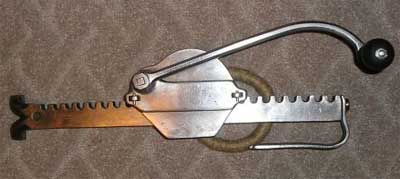
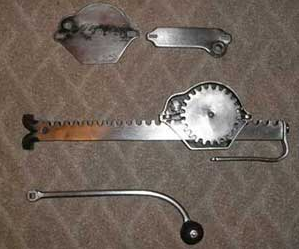
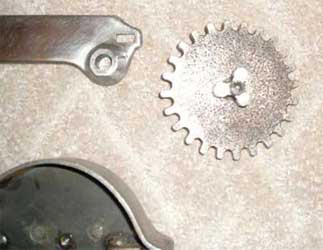
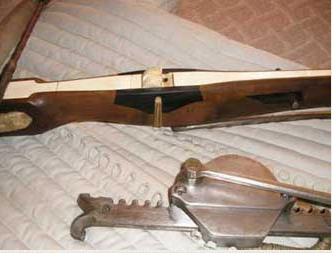
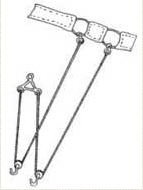
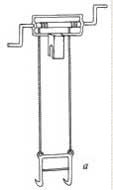
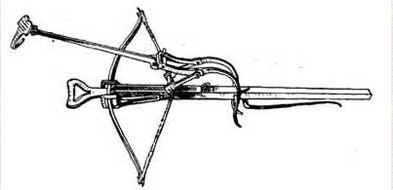
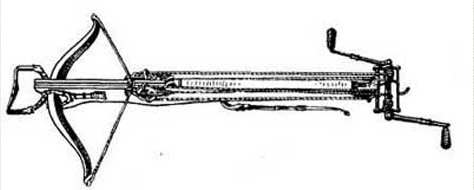
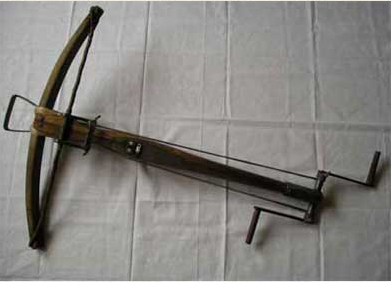
The rising quality of armour demanded more powerful crossbows. To span them, either simple windlasses and lever spanners acting by pull or push ("goat's foot") or the production-intensive English and German cranequins were used. The English cranequin reduced the force needed for spanning by means of several pulleys (2–6) over which ropes wound by a crank were led. The Old Czech term "kliky" was apparently used both for the English cranequin and for a windlass without pulleys. Its disadvantage was the possibility of the long ropes becoming tangled during battle, since after spanning it was taken off the weapon and hung on the belt. That is why the so-called German cranequin (Zahnstangewinde, in Old German Heber or Hebar) can be regarded as the most perfected spanner. It worked on the principle of a toothed rack with a hook for the bowstring, which was moved by a gear wheel with a pinion and a crank. It could span even the very strongest crossbows with a draw weight of up to 5500 N (though this frequently quoted figure apparently relates to later steel prods).
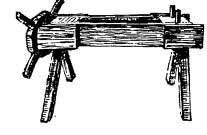
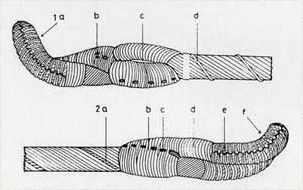
Such weapons pierced even plate field armour at a distance of several tens of metres. Besides slow operation, however, they also had other weaknesses that are overlooked today. All parts of the crossbow were extremely stressed (especially the antler nut and its housing), and damaged specimens have also survived. A weak point is also the attachment of the prod to the tiller by rope, which works loose under heavy shocks, reducing shooting accuracy. And last but not least, the short life of the bowstring. It is said to have lasted only a few dozen shots. Replacing it was not an easy matter, and for this purpose special benches were used into which the crossbow was fixed and a screw spanner was used either to bend the prod or to span a "false" bowstring, for which some prods had special notches located closer to the centre.
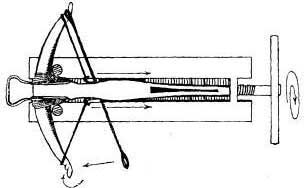
Fitting the bowstring using a second "false" bowstring on a special bench
Powerful crossbows with a German or English cranequin are rather rarely encountered in medieval paintings. Most surviving German cranequins date only from the Renaissance, when strong steel prods became widespread.
The ordinary military crossbow was, in my opinion, a plain weapon without ornament. Cladding with bone plates did increase the durability of the tiller, but it seems that the reasons were mainly aesthetic. The collections have preserved mainly hunting or sporting examples covered with bone plates and with polychrome prods. In their day these were luxury weapons, and precisely for that reason, unlike ordinary ones, they have survived to the present day.
Missiles
The missile for a crossbow, i.e. the bolt (in Old Czech "plitka" or "střiel"), consisted of a wooden shaft with two stabilising vanes and a forged point. The most commonly used points were those of square or rhombic cross-section, fitted to the shaft by means of a socket or a tang. Their shape was suited to piercing protective armour, especially mail. Other types of missiles were used to a lesser extent. A winged point with long cutting edges was probably intended, given its great wounding power, mainly for shooting at horses. It was precisely shooting at horses that brought confusion into a charging cavalry. This was directly required by the military regulations of the time. For example Václav Vlček of Čenov: "And those shooters who will be behind the pavise bearers shall shoot the horses before the clash and after the clash".
Points of other shapes occur exceptionally, e.g. with a forked body with two tips; a hollow point with holes, which whistled in flight; a sickle-shaped point with the tips facing forward. The stabilising vanes were usually made of thin leather, wood or paper. Plundering soldiery (that is, any ordinary army) was fond of using paper or parchment from looted books.
A special group is formed by points with engraved decoration (finds from Plačice, Mnichovice, Mstěnice). These bolts are mostly marked with a monogram and are regarded rather as ceremonial objects or badges. Some find circumstances, however, testify that they were also used in combat (Plačice).
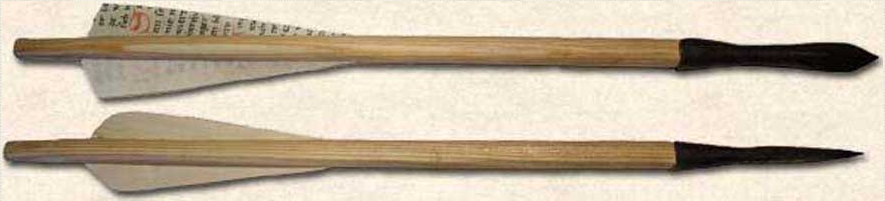
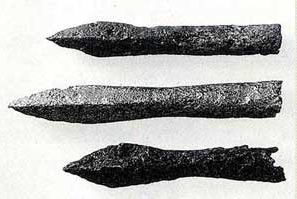
The accuracy of a standard medieval crossbow was not great at all. For war purposes, where the target was a man or a horse, it was certainly sufficient. When shooting replicas one can see for oneself the great influence of the forged point of the missile on accuracy. The points are not entirely symmetrical and, despite the smith's efforts, differ in both dimensions and weight. A certain role is also played by the symmetry of the prod's draw, which is not precise, especially when a belt hook is used. The properties of an authentic composite prod cannot be verified today, because the reconstruction of the original production technology has not yet been mastered in a satisfactory manner.
The advantage of the crossbow over the bow is the aforementioned ability to keep the weapon spanned for a long time, ready to fire at once. This was surely appreciated both by the fighter on the wagon fort and by the rider, who calmly spanned his crossbow and hung it from his saddle (which was certainly not without risk) so that he could then attack an opponent with it. A high rate of fire always brings with it the problem of supplying ammunition, and the lower rate of fire of the crossbow was not seen as a major shortcoming given the tactics employed. This assumption is also confirmed by the unprecedented development of firearms and their eventual victory over mechanical missile weapons.
|
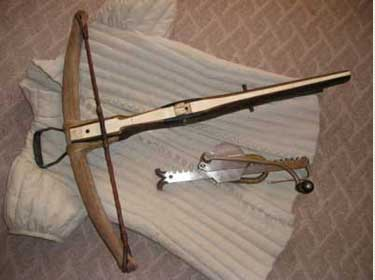
A transport cover protecting the crossbow from the weather |