
Three-Edged Arrowheads in Prehistoric Europe
Machine translation.
This page was machine-translated from Czech. The Czech version is authoritative.
Switch to original Czech version. · Zobrazit originál článku v češtině
Today we present an article by another of our readers. By his own account, Chouan has for several years been studying archaeological finds of archery equipment in Central Europe. He has therefore prepared a short two-part work on the subject of three-edged arrowheads in prehistory. It is a concise informative text which, for the more curious reader, is accompanied by a basic bibliography.
The Hallstatt Period and the La Tène Period
Three-edged arrowheads are known as early as the 3rd millennium BC from Egypt and from the territory of present-day Israel [9]. The oldest specimens are made of bone and in most cases have a tang. In Europe they appear only in the middle of the 2nd millennium, on the Apennine Peninsula and in the Aegean region [8]. By then, however, these are already bronze arrowheads with a socket, similar to the arrows known from our territory from the late Hallstatt period and the early La Tène.
Only in the Hallstatt period, and especially towards its end, did these points spread further into Europe. Some researchers, however, like to identify them already with the Cimmerians (1) and thus push their dating back to the Late Bronze Age. The Cimmerians, though, spread into Europe from a different direction. From the Mediterranean, particularly via the Greek colony of Massilia (present-day Marseille) into the territory of Western Europe, and via the Thracian trade connection through the Carpathian Basin into Central Europe. The influence of the Scythian ethnic group and its incursions into Central Europe should not be neglected either.
The situation is different in the Balkans. Here, probably under influence from the Aegean region, three-edged arrowheads begin to appear as early as the Late Bronze Age. From this period we know the first three-edged bronze arrows with a tang, from the cemeteries of the Plovdiv – Zimnicea culture in the territory of present-day Bulgaria. Later, in the Early Iron Age, they occur here in very large numbers and are bound chiefly to the Celtic, Thracian and Greek ethnic groups.
It is certainly no coincidence that in late Hallstatt and early La Tène Europe (2) we can distinguish two large find sites of three-edged arrowheads. These are characterised by a dividing zone between the Rhine and the Bohemian Forest. Only a few isolated finds were made in this dividing zone. The first large find site is present-day France; the accumulations of finds are particularly evident in Provence, the lower course of the Rhône, in the Vendée at the mouth of the Loire, and on the upper course of the Seine. The second is Central Europe itself, where finds of three-edged arrowheads are concentrated in central and north-western Bohemia, Moravia, Upper Silesia, the middle course of the Oder and the Vistula, and also in the territory of present-day Slovenia, southern and south-eastern Slovakia, and along the entire course of the Tisza. This suggests rather that three-edged points reached these areas chiefly along trade routes following watercourses, rather than through Scythian incursions (as older researchers concluded (3)). The topic was most recently treated in the work of H. Eckhardt [3]. In various variants this bronze arrowhead persisted into the period of the great Celtic expansion, and we can still encounter it in the period of the flat cemeteries (4).
The La Tène period is the time when the first iron three-edged arrowheads with a tang appear in the territory of Europe. This is perhaps an influence from the area of Iran or Central Asia. The Scythians may have become acquainted with them through their incursions into the Persian Empire, or rather through the Iranian Sarmatians. From the 2nd century BC the latter slowly began to push the Scythian ethnic group out of the Transcaucasus and Black Sea regions onto the Crimean Peninsula. They then slowly penetrated into the Carpathian Basin as well, and by the turn of our era the Sarmatian Iazyges were firmly settled between the Danube and the Tisza.
Among the Celtic ethnic group, three-edged iron arrows with a tang are not represented at all. The exception is the buffer zone between the Celts and the Scythians in the territory of present-day Romania and northern Bulgaria. There, however, elements of both ethnic groups merge to such an extent that we speak of a Celto-Scythian ethnic group. In this territory we find, in shared contexts, both Celtic military equipment and Scythian archery weaponry, in which these very iron three-edged arrowheads with a tang are numerously represented. The situation is the same for the Getae-Dacian ethnic group.
In the same period these arrowheads also began to establish themselves in the ancient Mediterranean. This was due not only to the presence of the Persian Empire in the eastern corner of the Mediterranean in the period of the 4th–2nd centuries BC, but above all to the campaign of Alexander the Great (5) and the subsequent incorporation of the Near East into the Hellenistic world. Thanks to this, in the 2nd century BC they also found their way into the equipment of the Roman army, as Syrian and Cretan archers were incorporated into auxiliary units under the dictator Sulla.
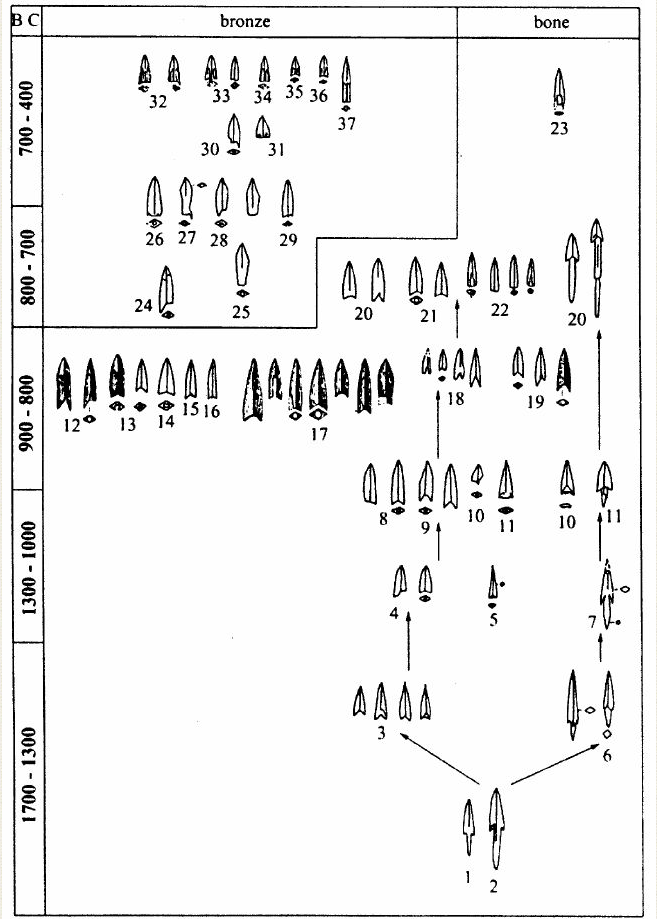
Diagram of the development of three-edged arrows in the Black Sea region, 1700–400 BC [Klochko 2001]:
Literature:
[1] - Brunaux J. L., Lambot B. (1987): Guerre et armement chey les Galois, Paris
[2] - Dušek M. (1978): Thraker im Karpatenbecken, Amsterdam
[3] - Eckhard H. (1996): Pfeil und Bogen. Eine archäologisch-technologische Untersuchung zu urnenfelder- und hallstattzeitlichen Befunden, Internationale Archäologie 21
[4] - Filip J. (1959): Keltská civilizace a její dědictví, Praha
[5] - Filip J. (1956): Keltové ve Střední Evropě, Praha
[6] - Filip J. (1959): Keltská civilizace a její dědictví, Praha
[7] - Kimming W., Gersbach E. (1971): Die Grabungen auf der Heuneneburg 1966-1969, Germania 49, Köln am Rein
[8] - Kleemann O. (1954): Die dreifügeligen Pfeilschpitzen in Frankreich, Abhhaltungen der Geistes- und Socialwissenschaftlichen Klasse d. Akademie der Wissenschaften und Literatur 4, Mains- Wiesdaban
[9] - Rausing G. (1967): The Bow, some notes on its orign and development, Lund
[10] - Reinecke P. (1941): Eine Dreikantige Boronzepfeilspitzene aus Oberfranken, Germania 25, Köln am Rein
[11] - Smirnov A. P. (1980): Skytové, Praha
[12] - Sulimirski T. (1936): Scytowie na zachodniem Podolu / Die Skyten in Westpodolien, Lwów
(1) They, however, used different arrowheads. These were bronze two-winged arrows similar to the arrowheads of the same period found in our territory and throughout Central Europe [3].
(2) Outside the area of the eastern Balkans, where these arrowheads clearly dominate.
(3) P. Reinecke, T. Sulimirski
(4) In our territory, for example, the child's grave from Jenišov Újezd.
(5) 334–330 BC