Interview with Vladimír Kýzl, bow maker at KyzlBows
Machine translation.
This page was machine-translated from Czech. The Czech version is authoritative.
Switch to original Czech version. · Zobrazit originál článku v češtině
(Tom Pollak, LK RAVEN – October 2024)
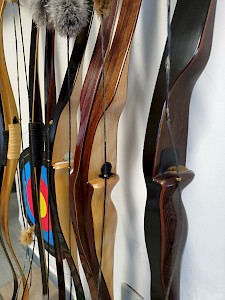
Why an interview? And why with Mr Kýzl? The idea came to me at the tournament in Habří. A fine row of bows was leaning against the wall of a former church there. But however I looked at them, most of the adult bows came from Mr Kýzl's workshop, i.e. Kýzl Bows. And it was there that it occurred to me that I could fulfil the commitment I made at last year's ATL general assembly – namely to contribute an article to the ATL website in 2024 – by asking for an interview with a man through whose hands hundreds and thousands of bows have passed. Perhaps even yours. We have as many as four at home!
The opening question is usually important and should be simple. And I have exactly such a one for you. When did you first hold a bow of your own in your hand, and what was it?
"Well, that was really a very long time ago. Our parents were something of adventurers, and basically whatever my brother and I wanted to try and finances allowed, they tried to make possible for us. So we had bows from an early age. We had bamboo bows, and we had a bow whose grip was made from a screwdriver, with two hardened wires stuck into it. Simply whatever the socialist market of the time offered, we had. But then a bow from Poland appeared. It was called Sokole oko. In shape it resembled today's deflex-reflex bows, it was reminiscent of our Cophan, but it didn't have such a sophisticated grip as today's bows have. It had a sight window and was not laminated, it was only glued together from layers of veneer. But at the time when we got it, it was an absolutely wonderful bow that all the boys envied us."
Have you ever competed in archery?
"No, I'm not the competitive type. People often come here and ask about some award, some trophies. They say: how can you guarantee me that the bow will be good…? And I answer them: that's easy, tell me – how many people do you know who make tennis rackets and win on tennis courts? Someone designs it, someone makes it and someone simply plays it, and I am the one who makes it. A bow interests me as a technical problem, as a challenge. Of course, when I want to shoot, I shoot, and a few people have seen that I can hit the target too, but I have never been to any archery competition. Which is perhaps a pity, because I think I wouldn't have placed the worst, but I'm not the type who needs to compete. I was originally a designer of measuring instruments, and spatial things, some 3D, I enjoy enormously. And a bow is a big challenge in the technical sense. When I started making bows, I tried approaching a number of acquaintances etc., and I consulted a physics professor about the possibility of using a mathematical model to design a bow, and I was told that it wasn't possible. Partly thanks to that I understood that a bow has to be designed gradually and with feel. So I bought a muzzle-velocity meter and began shaping bows in different ways and comparing their output parameters. When other people's bows came into my hands, I tried how each one behaved, and from these experiments and experience the specific final shapes of the bows crystallised. After several years we focused most of our effort on developing the Curon (author's note: the Curon is the best-selling bow model from the Kyzl Bows workshop). And here I dealt with the flexible part of the bow by scribbling on the bow, effectively dividing it into sections, and trying to measure it gradually and find out which part of the bow bends faster and which more slowly (I call it optimisation of the limbs). Accordingly, I narrowed or thinned the bow in places. On the Curon you can notice that in the grip section it has a minimally chamfered edge on the back side, i.e. on the belly of the bow, and towards the ends of the limbs the edge is chamfered more and more. And thanks to this bevelling, which is not done by machine but by hand with feel, I managed to fine-tune the Curon's limbs to my satisfaction. In a similar way I would like to fine-tune the limbs of, say, the Cophan or the Maro in the future (note: a pair of deflex-reflex bows from the Kyzl Bows workshop), because although in my opinion they are good bows, I think even more could be squeezed out of them. Nevertheless, as far as the near future is concerned, I would like to keep working on the Curon for a while. I wouldn't touch the shape much any more, I consider it optimal, but it is still possible to experiment with materials, glues, carbon and so on."
How does a designer of measuring instruments, basically a mechanical engineer, become such a specific kind of joiner as a maker of traditional bows? What had to happen for a father who once made two bows for his two little sons to become a leading Czech bow maker, whose work, and in fact hobby, keeps him in a living?
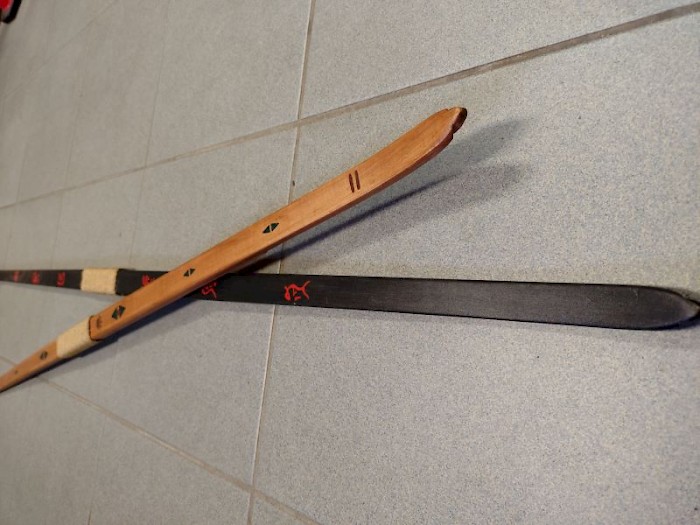
"If I take it from the beginning, after the Revolution (note for younger readers – by the Revolution we mean the so-called Velvet Revolution of November 1989), things didn't look good for the company where I worked, for several reasons, and I began working for a company making measuring instruments, but that was bad for my health; still, I stayed there for a few years, and in the meantime I began designing my first bows at home. The first two bows I made for my sons inspired a friend of mine, who asked me for another bow for his son. At the same time I took my first two bows to Prague to Mr Stanislav Vidím (author's note – S. Vidím is a long-standing Czech representative in archery and crossbow shooting and the founder of 3D archery in the Czech Republic), and he lent me some foreign bow as a "Musterstück" and told me to try to imitate it. So I made something that looked like this (shows one of the first bows – see photo), and I call it the screwdriver for short. It is basically a longbow with hints of reflex. It was my naive idea at the time of what a bow should look like. And I went to Prague with it to show it to him, and since there was hardly anything similar to be found on our market, he said it was good and that if it was of that quality, he would take everything I made. So I made another 8 pieces, and to this day I remember carrying them wrapped in black cellophane on a bus, and the driver shouting at me to put those skis down in the luggage compartment. I should add that it was summer, and I refused to put the bows in the luggage compartment, insisting that they had to stay up with me. So those were the very beginnings."
Did these first bows have a name, and did they already carry your brand? And what came next?
"They were called something like Old Shooter and carried our original brand. At the beginning I imagined that our company would consist of me and my two sons. I'm Láďa, the older son is Jakub and the younger is Tomáš. So the first brand was LAJATO. And above that inscription there was a little figure with a bow in his hand standing on a hill, with a stylised sun behind him and the shadow cast by the little man pointing downwards. That was the picture I had on stickers, and I stuck them on those bows of mine. The next big leap came when I started taking laminate directly from the German company Black Flash. After an agreement and a trip to Germany, I began making bows for them too, and thus for the German market. That was the time when Mr Vidím took roughly 600 bows a year from me, and we gradually supplied a similar number to Germany each year. Over time, however, demand kept growing and it began to exceed our production capacity. So we started selling only to Germany, with the company selling the bows on throughout Europe. Then COVID-19 came, with its transport problems. Until then I had delivered the bows to Germany personally, but after that the options were limited and orders began piling up on me here. At the same time, an opportunity appeared to send a bow for testing to Mr Armin Hirmer (see the video reference on the Kýzl Bows website, under Our bows). The question was which bow to send. The choice logically fell on the Curon, and we waited for the review, hoping that it would be average or better. But Mr Armin Hirmer's review was so excellent that interested customers began contacting us from practically all over the world. To give you an idea, people from Hong Kong, Sydney, South Africa, the USA and Canada got in touch with us. After a certain time, of course, that interest partly subsided, and today we sell bows mainly to Europe. Many of our bows go to Scandinavia, and there has recently been great interest in Poland, which is a big market."
How long did it take you to be satisfied with your bows? When did you start to be truly proud of what is created in your workshop?
"That is a hard one to answer. As you work, you often feel that you have just done the best you could. And then, when you look back after a longer time, you say to yourself: "no, that won't do, it can't be done like this – you've seen that first screwdriver of mine…"," Mr Kýzl remarks with a smile. "I will never be completely satisfied, and that motivates me to keep improving the bows."
What I'm getting at with my question is that a prospective bowyer should learn from you how long it takes before one reaches a level that can be considered acceptable…
"Well, for example, my brother, also a mechanical engineer, who once worked as a vocational training instructor, told me the other day that if it were taught as a craft, then an applicant – assuming he were seriously interested in learning bow making – would have to have about 5–6 years of practice here in the workshop before he could stand on his own feet. But a great deal depends on the individual qualities of the person. We, for instance, are still learning even now, after 26 years. Only recently, for example, we discovered a small detail that had bothered me all those years and that I didn't know how to deal with…"
What exactly was it, if I may ask?
"It concerned the Curon again, which is a relatively slim bow, and especially when it is made with fast carbon, it is very difficult to hold the limbs so that they don't cheat, as we say. Similarly, it took me years to find the solution to the problem of how the amount of pressure when gluing two veneers relates to how the resulting double layer then twists by as much as 90 degrees. And those are precisely the things that can perhaps be learned in theory, but mostly you have to arrive at them through practice."
Now the information about at least 5 to 6 years of practice makes more sense to me… The truth is that a standard apprenticeship is 3 years, and 2–3 years of practice on top of that is probably a necessity…
"Of course, this probably can't be done any faster. But there is one more important thing I would like to tell prospective students of this craft. You have to realise that this work is risky with regard to human health. It is hard on the lungs, a lot of chemistry is involved and so on. At the same time, the idea that I will work for days and weeks wearing a respirator is unfortunately naive, it is hard to endure. It is a fact that during COVID, things such as respiratory protective equipment advanced greatly and underwent enormous development in quality; in that respect this period was positive. In conclusion I would like to say that it is not a job for a pure-bred mechanical engineer, nor for a pure-bred joiner. What paid off for us was that in our youth my brother and I worked on our own small sailing boat, where we were already working with epoxies and the like back then, and that came in handy for us here."
Thank you for the realistic assessment of the risks associated with the bowyer's craft, those are certainly worth knowing before one gets into it. But now tell me from the opposite end – why should anyone try it? What is interesting about becoming a bowyer?
"Because when a bow turns out well, it's a wonderful feeling. And when someone sends you a photo of a group of good shooters and almost every one of them is holding a Curon or another of our bows in their hand, it simply warms your heart and pleases you. Or you get an e-mail saying that the owner is taking our bow with him from Europe to the USA, where he will use it as his main hunting bow. Another exotic example is a Chinese woman living in Sydney, who had two bows made by us and now shoots only the Curon. That pleases you, and from such feedback you get a sense of fulfilment. But it also has to be said that in all those years I have not got rich from making bows. You can make a living from it, but it is simply not a way to get rich."
And one more question about making a bow. This interview may also be read by less technically minded readers, so could you describe, in lay terms and briefly, the story of each of your bows – I mean the individual stages of production up to the final product?
Occasionally someone gets in touch who wants to make a bow exactly to his own ideas. I try to turn such projects down, because I don't have the capacity for them, but to give you an idea – it would take roughly a week just to make the mould, which I then – in the case of a specific brief – would probably never use again.
We have a number of our own models, from which the customer chooses, and then it is only a matter of settling the design. It is possible to choose the wood and the colour, and occasionally someone has something really special made. Once a customer came, tipped a handful of gold pieces onto my brother's table and said he wanted them incorporated into a grip in the shape of a dragon. It was his split wedding ring… :-).
But back to the point – when the customer chooses a specific model, we use a specific mould, and that decides the shape of the bow. Beyond that, the difficulty of production depends on the customer's requirements. If it is the basic version, i.e. Ovangkol, ash strips, two laminates are used, and my brother and I are both in the workshop, the bow can theoretically be finished within three days. But that is rather an exception. If it is a more complicated bow, say just a grip glued from three woods, or a bow that is atypical in some other sense, e.g. the customer wants a different draw weight from what is usual for the given bow length (i.e. at a draw length of 28 inches), then the production process, and therefore the delivery date, is considerably longer.
For example, if someone wants a special grip using several woods, carbon and so on, in practice I have to make two bows – one with a wooden grip and the other the custom one (the one requested). On the wooden one I first verify that everything will work, above all whether the limb strength comes out right, and only then do we go on to the custom one, which will be so much more expensive to produce that, if it were not dimensioned correctly, it would probably just stay lying here as an unsellable relic."
Do a longbow and a recurve bow differ significantly in terms of production? If I put the Sentinel and the Maro side by side, will there be differences in the production process?
"In terms of bow parameters, there are definitely differences. In terms of production, the bows hardly differ at all; there is nothing especially special about it. I can't say that one type of bow or the other is more labour-intensive in terms of gluing, sanding and so on. Occasionally there is more work with a pistol grip, but nothing major. The big differences in bow parameters are, of course, down to the materials used."
And which bow do you personally like best? And please don't say it's the Curon. So?
"Of course it's the Curon! I like it because the feeling when shooting it is simply the best. The best of all the bows I have here and that we make. I compared the Curon with other bows, including the bow that received the best review from the aforementioned Mr Armin Hirmer, who said it was the best traditional bow he had tested. But when I compared the feel of the draw of that award-winning bow with our Curon, it seemed to me that while the first bow has a draw that is split into phases in terms of the energy expended, the Curon draws smoothly and feels far more pleasant. And these were bows of comparable strength (35 pounds).
What fascinates me most about the Curon is its understated simplicity combined with performance. After all, I have a Curon, my brother has a Curon, my son shoots with a Curon, so there must really be something to it...", says Vladimír Kýzl with a smile.
Now a question from the other end. Have you ever experienced a moment when you really wanted to give it all up?
"Well yes, there were actually two. The first was when I was making my first bows. I used a laminate that I think came from Tišnov; it had a somewhat coarser structure and was also glued with a different type of resin. Those bows gave off a great deal of dust when sanded, glass fibres were flying off them, and when I was lying in bed after a shower and could feel those little glass fibres everywhere, I told myself this was beyond me and that it wasn't worth it. You see, at first I only made wooden bows. But above 25 pounds you had to add laminate to the bows, and the first experience was precisely this not exactly positive one.
The second moment, which I personally consider more serious, is connected with the limb tips. For a long time we used so-called Fenolit. This material was made by a Czech company, and we bought boards from them from which we made the tips. The material had a standardised composition and was exceptionally durable. We even made tips for a crossbow with a draw weight of 300 kg (note: that is, for interest, almost 600 pounds!) and everything held up. We made, for example, the Lanura for Germany with a draw weight of over 130 pounds, I know of a 110-pound Curon, and everything was fitted without problems with the aforementioned Fenolit. But after 17 years we had used up the original material, so we decided to buy Fenolit boards again to keep in stock for X years. That is, identical material, the same standard and the same manufacturer. So we began using tips made from the new boards, but from a proven material, and we sent bows all over the world. But the tips began to crack, or the whole bow was even damaged as a result of the tip splitting, and we had to either deal with complaints and repairs or even supply brand-new bows to replace the damaged ones. Although there weren't many cases, we naturally faced the problem head-on and preventively recalled bows from practically all over the world to prevent people's tips from starting to crack. Later I tried to claim compensation for the Fenolit boards, but it came to nothing. In the meantime we discovered G10, whose parameters proved ideal for the tips. Today we use both the white and the dark variant of G10, which has the same specific weight as the original Fenolit but significantly higher strength. The whole thing was costly and time-consuming, but we managed it. It was not a pleasant situation, though."
What would I have to do to be able to start making bows tomorrow?
"At the beginning it is of course a question of know-how. But in today's age of the internet that is not a problem. You can really find everything there nowadays. Then you need to use suitable glues. I glue the weaker children's bows with a Czech glue, and the finer bows with a glue from Mr Petr Čížek. I tried comparing this glue with the classic UHU300, and the results were comparable. But it is important to watch out for dust when gluing. Further questions concern the time and temperature suitable for gluing; again, it's all on the internet.
Another question is the materials used, that is, the veneers. I definitely wouldn't make a bow from beech; ash, which is often used, is of variable quality. Of our native woods I personally recommend maple, which is a very rewarding wood. Among foreign ones, bubinga is good, for example. But I would advise a beginner to glue a bow from maple. If you want it to look nicer, you need to insert an underlying layer, some decorative veneer; it must in any case be strong. You will also need a small oven for curing the glue. It is not essential, but it is a handy help. Of course you must not heat the bow to more than 100 °C, otherwise the residual water inside starts to boil, which could tear up the internal structure of the wood. So I recommend about 90 °C and leaving it to dry in the oven for 6 to 7 hours. And how do you make a form? That is actually quite simple. You choose a bow that you like and that shoots well, and you trace it. You cut out the form and you can get started. In the workshop you shouldn't be without basic woodworking machines and tools, which can be bought readily today. A belt sander will certainly come in handy, a proper saw is a must, and then sets of tools for rasping and sanding. You must of course be reasonably skilled and, above all, learn quickly from your mistakes."
Are there any novelties awaiting KyzlBows in the near future? Are you preparing anything, some product for which you would like to pave the way, so to speak, through this interview?
It's not like that. I can't answer yes to either of those questions. At the moment we are behind schedule, we have a number of orders, and we are rather trying to serve the current orders. So our goal now is mainly to maintain production and meet our commitments. Personally, though, I keep trying to fine-tune the quality, I play around with materials and deal more with details. I still feel there is room to improve. But having some new type of bow up our sleeve – that is not the case.
It is also a question whether the current portfolio, and especially the Curon, can be fundamentally improved at all...
"I think everything can be surpassed, and personally I would dearly love to have another 30 years at my disposal and the chance to use modern materials such as those used in astronautics, nanotechnology and so on; that is where I would like to improve and try to apply it in production.
To close our interview, is there anything you would like to say, for a change, to the readers, who are mostly archers?
I really appreciate people's interest in our bows. As I said at the start, I don't travel to tournaments and collect laurels; I just try to make the best possible product. And I am very pleased that people like our bows and that they come back to them across generations.
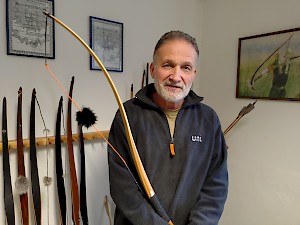
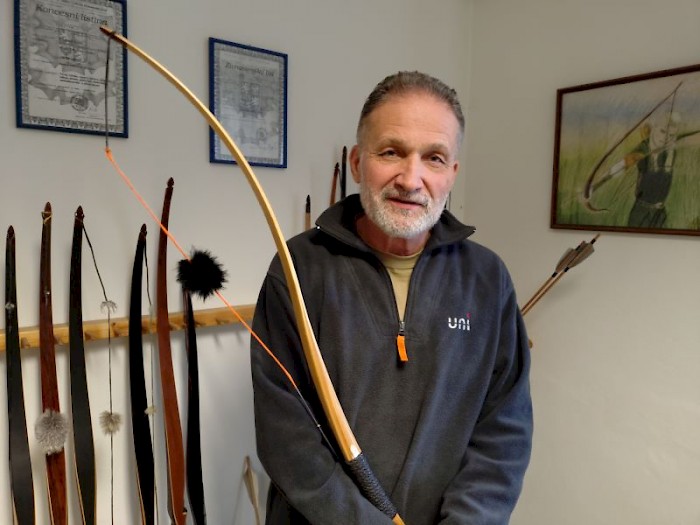
Mr Vladimír Kýzl in his office
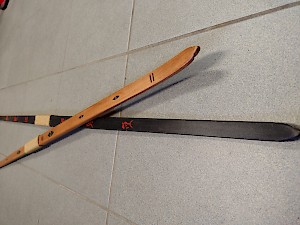
the first bows that Vladimír Kýzl made for his sons Tomáš and Jakub
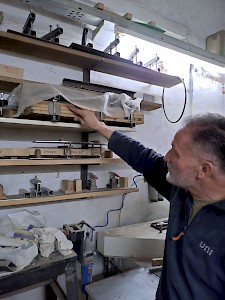
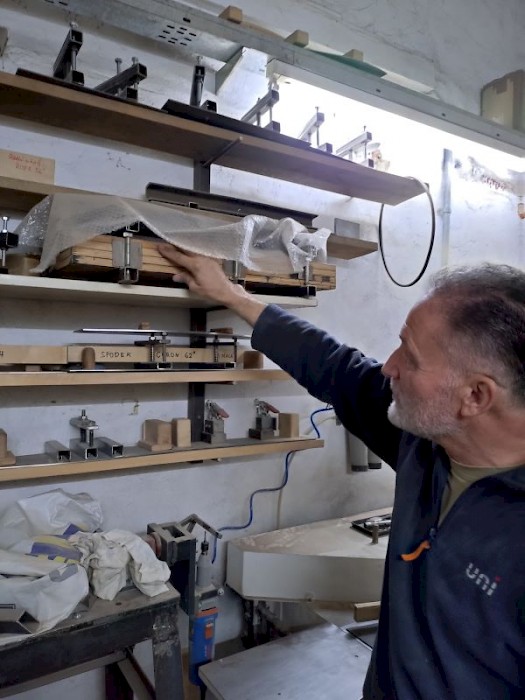
Vladimír Kýzl showing various jigs for grips for the copy sander
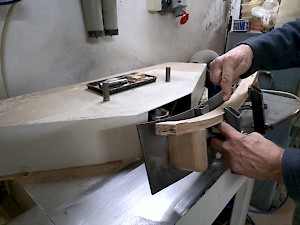
and here, for a change, a jig for sanding the functional surfaces of the grip, here for the Curon with a small grip
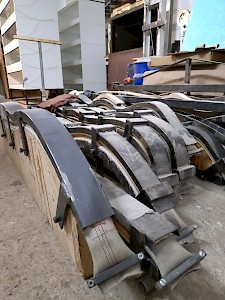
this is what the forms for gluing bows look like – some final, others experimental